

Emergency Dental Care in Bhopal
In pain, or hurt your tooth? Call or WhatsApp us. We see urgent cases as early as we can.
Call or WhatsApp +91 92007 00750. Smile Gallery Dental Wellness Centre in Arera Colony, Bhopal treats severe toothache, a knocked-out or broken tooth, swelling or an abscess, bleeding, and a lost filling or crown. We see urgent cases as early as possible, Monday to Saturday, 10 AM to 2 PM and 5 PM to 9 PM.
It is evening and your tooth is pounding. Or you fell, and a tooth is chipped or gone. You are scared, and you want someone to tell you what to do. We will.
The first hour matters. What you do before you reach a dentist can decide whether a tooth is saved. Below, in plain steps, is what to do right away, what can wait for the clinic, and what should not wait at all. Dr. Saurabh Shrivastava and our team see urgent cases as early as we can during clinic hours.
What counts as a dental emergency?
A dental emergency is sudden severe pain, a facial or gum swelling, a knocked-out or broken tooth, bleeding that does not settle, or a toothache that pain relief will not touch. If you are unsure, call us. It takes a minute to describe, and we will tell you how urgent it is.
If the pain is keeping you up, or you are afraid it is serious, trust that feeling. Treat these as urgent and contact us as soon as you can:
- Severe or throbbing toothache: pain that keeps you awake, or does not ease with pain relief
- Knocked-out tooth: an adult tooth has a better chance when it is put back or kept moist and seen by a dentist as soon as possible
- Broken or cracked tooth: especially with sharp pain, bleeding, or a visible pink or dark centre
- Swelling of the gum, cheek or face: a pimple-like boil on the gum, or a puffy cheek, can mean an abscess
- Bleeding from the mouth: after an injury, or after a tooth removal, that has not stopped with firm pressure
- Lost filling or crown: urgent if the tooth hurts or is sharp, otherwise book soon so the tooth does not break
A small chip with no pain, or a tooth that is only a little sensitive, can usually wait for a regular appointment. A dentist should still look at it soon.
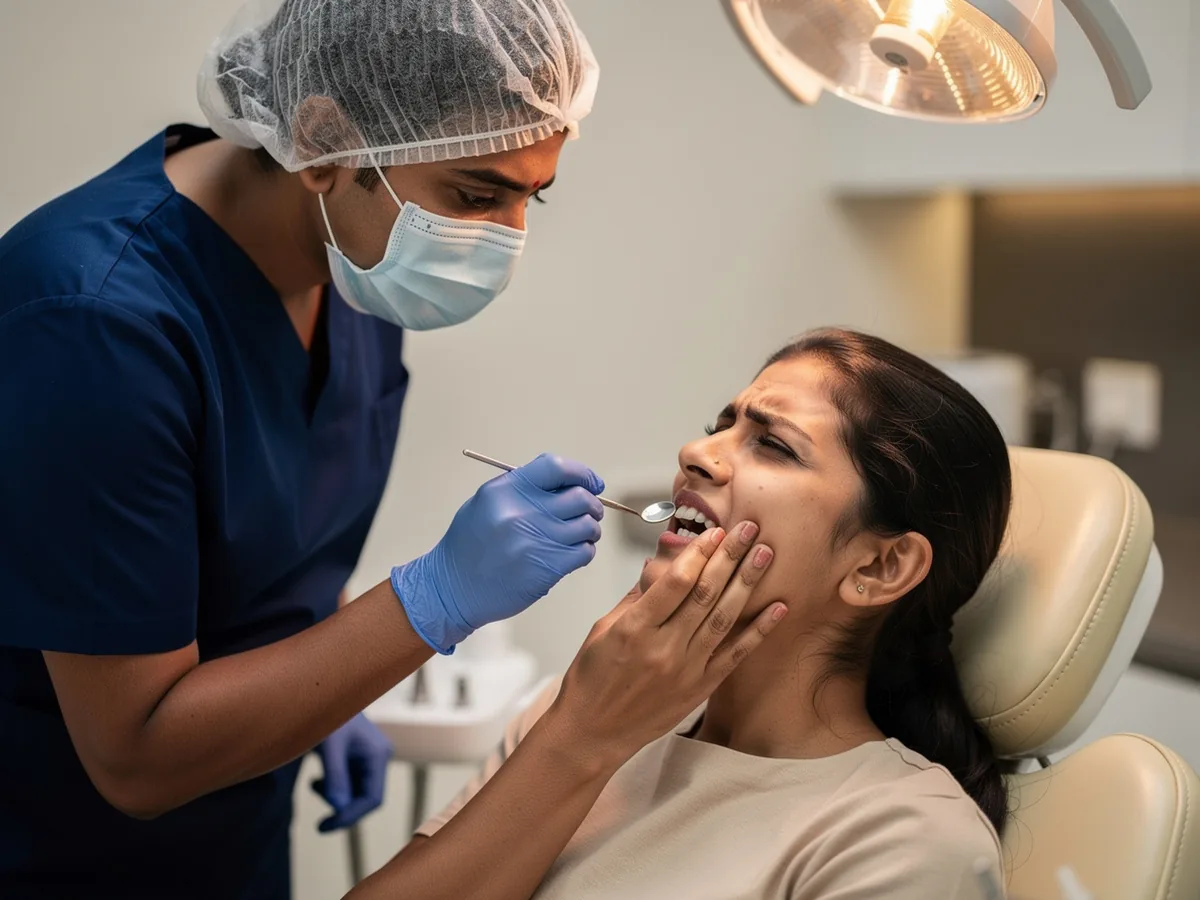
What should I do first, before I get to the clinic?
Stay calm, keep the area clean, and call us. For a knocked-out tooth, hold it by the crown and get to a dentist as soon as possible. For pain, rinse with warm salt water and use a cold compress on the cheek. For bleeding, press firmly with clean gauze or cloth for 10 minutes.
Take a breath. These steps are simple, and you can do them at home right now.
| Situation | Do this now | Avoid |
|---|---|---|
| Knocked-out adult tooth | Pick it up by the crown (the white part). If dirty, rinse gently with milk or clean water for a few seconds. If you can, place it back in the socket and bite gently on a clean cloth; if not, keep it in milk or inside your cheek and come straight to us. | Touching the root, scrubbing it, wrapping it dry in tissue, or letting it dry out. Do not replant a knocked-out baby tooth. |
| Severe toothache | Rinse with warm salt water, floss gently to clear trapped food, hold a cold compress against the cheek (15 minutes on, 15 off). A common pain tablet such as paracetamol or ibuprofen can help if you can safely take it; follow the label or your doctor's advice. | Putting aspirin on the gum (it burns the tissue), very hot or cold food, and sugary snacks. |
| Swelling of the cheek or gum | Use a cold compress on the outside of the cheek, keep your head raised, and call us as soon as you can. Swelling can mean infection. | Heat packs, pressing or squeezing the area, or waiting to see if it settles. |
| Broken or chipped tooth | Rinse with warm water, keep any broken piece in milk, and cover a sharp edge with dental wax or sugar-free gum. | Biting on that tooth, or poking at it with your tongue or a pin. |
| Bleeding gum or after an injury | Press firmly with clean gauze or a cloth for 10 minutes. Sit upright and do not rinse hard. | Spitting repeatedly, rinsing hard, or hot drinks while it is bleeding. |
| Lost filling or crown | Keep the crown safe if it came out whole and bring it with you. Cover a sensitive tooth with sugar-free gum or a dental cement from a pharmacy. | Using household glue, or chewing on that side. |
These steps buy you time. They do not treat the cause. A tooth in severe pain has an infection or a damaged nerve that needs a dentist, even if the pain settles for a while. Please still come in.
When should I go to a hospital instead?
Go to a hospital emergency department if you have swelling that is spreading across the face or neck, trouble breathing or swallowing, bleeding that will not stop after 10 to 15 minutes of firm pressure, or a serious injury to the head, face or jaw.
Some things are bigger than a tooth. If you see any of these, go to a hospital first, even if it feels like an overreaction. It is not.
- Face or neck swelling that is getting bigger fast, or swelling under the tongue or chin
- Difficulty breathing, swallowing or opening the mouth, or a fever with a toothache
- Heavy bleeding that does not slow with firm pressure
- Head, face or jaw trauma: a blow to the jaw, loss of consciousness, vomiting, or a jaw that looks out of place
An untreated tooth infection can spread beyond the jaw. Please do not wait for the clinic to open if you have any of these signs. Once you have been looked after, we can help with the dental part of the problem.
What patients say about being in pain
★★★★★ 5.0 · 477 Google Reviews"I m very happy with the root canals and crowns work. I was in severe pain and came to know about the treatment and actually it was painless. As the doctor suggested and it went very nice and delightful"
What treatment can follow an emergency visit?
First we ask what happened, examine the tooth, and take an X-ray where needed so we can relieve the pain and find the cause. The treatment that follows depends on the tooth: a root canal, a crown, removal of a troublesome wisdom tooth, repair of a broken tooth, or replacement if a tooth is lost.
Most people fear the treatment more than the pain. Here is what usually happens, so there are no surprises.
- Assessment and relief: a careful look at the tooth, gums and bite, with an RVG X-ray where it is needed, and treatment to settle the pain
- Infected or deeply cracked tooth: often saved with a root canal treatment. Where suitable it can be done in one visit as a single sitting root canal
- Broken or weakened tooth: rebuilt and protected, sometimes with a crown
- Swollen, painful wisdom tooth: see wisdom tooth removal (surgical removals are done with our visiting oral surgeon)
- Tooth that could not be saved: we then talk through ways to replace it, such as a dental implant or other missing-tooth treatment
- Anxious or in a lot of pain: read how we keep care gentle on our painless dental treatment page
What we recommend depends on the examination, and we explain the plan before we start. For anything that is not an emergency, you can book through our contact page.
Treated before and it still hurts? See our second opinion and re-treatment page.
How can I prevent a dental emergency?
Most dental emergencies grow out of small problems left alone. A check-up and cleaning at regular intervals, treating a cavity while it is small, and wearing a mouthguard for contact sports prevent most of them.
Nobody wants to go through this twice. A few small habits make it much less likely.
- Treat small problems early: a cavity or a sensitive tooth is far easier to fix before it becomes a toothache at night
- Do not bite hard objects: ice, pen caps, packaging and hard sweets crack teeth
- Wear a mouthguard for contact sports
- Get a crown on a tooth that has had a root canal, as advised, so it does not break
- Keep our number in your phone: +91 92007 00750
Questions, answered
Frequently Asked Questions
Straight answers to what patients ask us. Anything else, message us on WhatsApp.
What is classified as a dental emergency?
A dental emergency is a sudden, serious problem in the mouth that needs urgent attention. The most common are severe toothache, an abscess or infection, a knocked-out tooth, a cracked or broken tooth with pain, bleeding that will not stop, and facial swelling. If you are not sure, call us and tell us what is happening.
What should I do if my tooth gets knocked out?
Move quickly, but do not panic. An adult tooth has a better chance when it is put back or kept moist and seen by a dentist as soon as possible. Pick it up by the crown, never the root. If it is dirty, rinse it briefly in milk or clean water without scrubbing. Place it back in the socket and bite gently on a clean cloth, or keep it in milk, and get to a dentist straight away. Do not replant a baby tooth.
How do I stop severe tooth pain right now?
Rinse with warm salt water, gently floss out any trapped food, and hold a cold compress on the cheek for 15 minutes at a time. A common pain tablet can help if it is safe for you to take it. Follow the label or your doctor's advice. Do not put aspirin on the gum. These steps only buy time, so please see a dentist as soon as you can.
Is a cracked or broken tooth an emergency?
It depends. A small chip with no pain is not usually an emergency, but it should be checked soon. A crack with sharp pain, bleeding or swelling, or a broken piece that exposes the inside of the tooth, should be seen as soon as possible. Keep any broken piece in milk and bring it with you.
Can a dental abscess be dangerous?
Yes. An abscess is a pocket of pus from an infection at the root of a tooth or in the gum, and if untreated it can spread to the jaw and neck. If your face swells, you get a fever, or you have trouble breathing or swallowing after a toothache, go to a hospital emergency department right away.
Is a root canal an emergency?
It can be. The first sign that a tooth needs a root canal is often pain from an infected nerve. If the pain is severe or there is swelling, treat it as urgent. A root canal removes the infection and can save the tooth. You can read about it on our root canal treatment page.
Is a black tooth an emergency?
Not always. A black or dark tooth can mean decay, an old filling, or a nerve that has died after an injury. If it is painless, book a check-up soon. If it is painful or swollen, or if it turned dark after a knock, call us as soon as you can.
What are your timings for urgent dental care in Bhopal?
The clinic is open Monday to Saturday, 10 AM to 2 PM and 5 PM to 9 PM, and is closed on Sunday. You can call or WhatsApp +91 92007 00750 between 10 AM and 9 PM. We see urgent cases as early as possible within these hours. If you are in severe distress outside these hours, go to a hospital emergency department.
Where is Smile Gallery for emergency dental care in Bhopal?
Smile Gallery Dental Wellness Centre is at E-4/205, Main Rd 3, near Flower Market, E-4, Arera Colony, Bhopal, Madhya Pradesh 462016. Please call or WhatsApp +91 92007 00750 before you set out, so we can be ready for you.
अक्सर पूछे जाने वाले सवाल (Hindi FAQs)
Agar daant tootkar bahar nikal jaye to kya karein?
Daant ko jad se nahi, upar ke safed hisse (crown) se pakdein. Gandha ho to doodh ya saaf paani mein halka sa dho lein, ragdein nahi. Ho sake to use wapas jagah par rakh kar saaf kapde par halke se kaatein, warna doodh mein rakhein aur jitni jaldi ho sake dentist ke paas aayein. Doodh ke daant ko wapas na lagayein.
अगर दांत टूटकर बाहर निकल जाए तो क्या करें?
दांत को जड़ से नहीं, ऊपर के सफेद हिस्से (क्राउन) से पकड़ें। गंदा हो तो दूध या साफ पानी में हल्का सा धो लें, रगड़ें नहीं। हो सके तो उसे वापस जगह पर रखकर साफ कपड़े पर हल्के से काटें, वरना दूध में रखें और जितनी जल्दी हो सके डेंटिस्ट के पास आएं। दूध के दांत को वापस न लगाएं।
Tez daant dard mein turant kya karein?
Gungune namak ke paani se kulla karein, gaal par thanda sek (15 minute lagayein, 15 minute chhodein) karein, aur jo dard ki goli aapke liye surakshit ho woh label ya apne doctor ki salah se lein. Masude par aspirin na rakhein. Yeh sirf thodi der ka aaram hai, isliye jaldi dentist ko dikhayein.
तेज़ दांत दर्द में तुरंत क्या करें?
गुनगुने नमक के पानी से कुल्ला करें, गाल पर ठंडा सेक (15 मिनट लगाएं, 15 मिनट छोड़ें) करें, और जो दर्द की गोली आपके लिए सुरक्षित हो वह लेबल या अपने डॉक्टर की सलाह से लें। मसूड़े पर एस्पिरिन न रखें। यह सिर्फ थोड़ी देर का आराम है, इसलिए जल्दी डेंटिस्ट को दिखाएं।
Kab hospital ki emergency mein jana chahiye?
Agar chehre ya gale par sujan tezi se badh rahi ho, saans lene ya nigalne mein dikkat ho, khoon 10 se 15 minute dabane par bhi na ruke, ya sir, chehre ya jabde par gambhir chot lagi ho to seedha hospital ki emergency mein jayein.
कब अस्पताल की इमरजेंसी में जाना चाहिए?
अगर चेहरे या गले पर सूजन तेज़ी से बढ़ रही हो, सांस लेने या निगलने में दिक्कत हो, खून 10 से 15 मिनट दबाने पर भी न रुके, या सिर, चेहरे या जबड़े पर गंभीर चोट लगी हो तो सीधे अस्पताल की इमरजेंसी में जाएं।
Sources
- NHS: Knocked-out tooth — hold an adult tooth by the crown and do not touch the root, keep it in milk, do not put a baby tooth back, and see a dentist as soon as possible.
- ADA MouthHealthy: Dental emergencies — keep a knocked-out tooth moist, do not put aspirin on the gum, floss gently to remove trapped food, use a cold compress, and call your dentist or go to an emergency room as soon as possible.
- NHS: Toothache — rinse with warm salt water, ibuprofen or paracetamol can ease pain, and swelling that makes breathing, swallowing or speaking difficult needs urgent hospital care.
- NHS: Dental abscess — an abscess will not go away on its own and needs urgent dental treatment; trouble breathing, swallowing or opening the mouth is a reason to go to hospital.
Who treats you
Book a visit
In pain or had an injury? Call or WhatsApp us.
Send a photo of your teeth on WhatsApp. A real person from the clinic, not a bot, replies honestly. Darr lag raha hai? Pehle sirf baat kar lijiye.
Calls & WhatsApp 10 am–9 pmSmile Gallery Dental Wellness Centre
E-4/205, Main Rd 3, near Flower Market,
E-4, Arera Colony, Bhopal 462016
One last step: tap Send in WhatsApp so we know it’s really you.
Open WhatsAppCalls & WhatsApp 10 am–9 pm