
A water flosser for teeth cleaning is safe and beneficial for most people. Used at the right pressure, it flushes food and soft plaque from around braces, bridges, and implants, and is gentle enough for sensitive gums. It supports daily brushing and a six-monthly professional clean — it does not replace them. For a personalised check, book a consultation at Smile Gallery Dental Wellness Centre, Arera Colony, Bhopal — call +91 9200700750.
Medically reviewed by Dr. Saurabh Shrivastava, MDS Prosthodontist (DCI A-04860, IDA 75737), Certified Digital Smile Designer (DSD). Last updated: May 2026.
A water flosser for teeth cleaning is one of the most useful home-care upgrades for the right patient. Dr. Saurabh Shrivastava, MDS Prosthodontist (DCI A-04860) at Smile Gallery Dental Wellness Centre, Arera Colony, hears the same questions from patients across Habibganj and Bhopal: do they actually clean, what are the benefits, what pressure should I use, and are there any side effects? This guide answers each one — and explains how good teeth cleaning habits at home support, never replace, the in-clinic professional cleaning recommended every six months.
What Is a Water Flosser & How Does It Clean Teeth?
A water flosser, or oral irrigator, fires a pulsed jet of water between teeth and along the gum line to flush out food and disturb soft plaque before it hardens. It cleans spaces a thread struggles to reach, though it works alongside brushing rather than replacing it.
"Waterpik" is simply the best-known brand — the device category is an oral irrigator. It dislodges food particles, disrupts the soft plaque film, and rinses the area. It is not a sandblaster: at the right setting it is gentle enough for sensitive gums and safe around braces, bridges, implants, and crowns. Where string floss scrapes the contact point between two teeth, a water flosser reaches spaces a thread struggles to enter.

Benefits of a Water Flosser for Teeth Cleaning
A water flosser flushes away food and soft plaque, reaches around braces and bridges where floss cannot, is gentle on inflamed gums, and is easier to use for anyone with limited hand dexterity. Most people also find they actually keep using it, which matters more than any single feature.
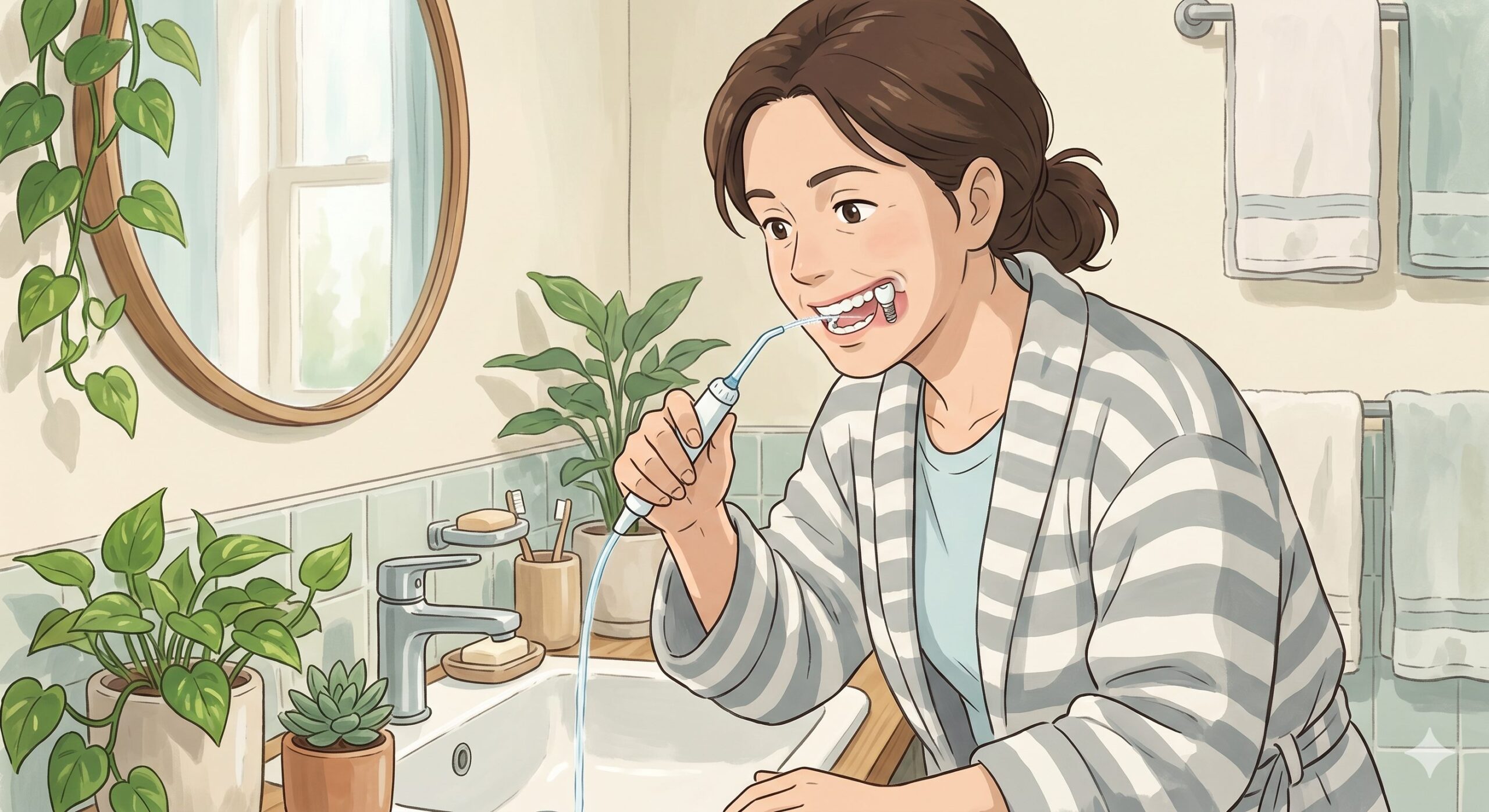
- Food debris between teeth and around appliances
- Loose, soft plaque film before it hardens
- Bacteria around braces, bridges, and implants
- Debris left after a professional teeth cleaning
- Hardened tartar / calculus — needs scaling by a dentist
- Set biofilm bonded to the tooth surface — needs brushing
- Surface stains from tea, coffee, or tobacco
- Anything deep inside a periodontal pocket
The real benefit is consistency: a water flosser supports a thorough clean and makes daily interdental cleaning easy enough that patients actually do it. It never replaces the six-monthly professional clean — once tartar has hardened, only scaling and gum care at the clinic will shift it.
According to Dr. Saurabh Shrivastava, MDS Prosthodontist: "The question I get asked most often about water flossers is whether they replace string floss. The answer is no — and the reason is mechanical. String floss physically wraps around the tooth and scrapes the plaque film off the contact area between teeth. Water under pressure dislodges food and disrupts plaque before it matures, but it does not replicate that scraping action. Both have a role; they work better together than either does alone."
Water Flosser vs String Floss
No single tool wins on everything. Water flossers excel around appliances and inflamed gums, string floss scrapes the contact points between teeth better, and interdental brushes suit wider gaps. Many people do better by combining a water flosser with floss or brushes rather than choosing one.

| Water flosser | String floss | Interdental brush | |
|---|---|---|---|
| Removes soft plaque | Good (flushes) | Excellent (scrapes) | Excellent (scrubs) |
| Around braces / implants | Excellent | Difficult | Good |
| Gum-friendly when inflamed | Excellent (low pressure) | Can hurt / bleed | Good |
| Ease for low dexterity | Easiest | Hardest | Moderate |
| What it misses | Bonded biofilm at contact point | Wide gaps, under bridges | Very tight contacts |
For most healthy mouths the gold standard is brushing twice a day plus daily interdental cleaning. For braces, bridges, implants, or compliance struggles, adding a water flosser is what makes that daily cleaning actually happen — a point supported by clinical trials comparing water flossing with string floss.
Is a Water Flosser Safe? Any Risks or Side Effects?
Yes, a water flosser is safe for most people and does not harm healthy or healing gums when used at a comfortable pressure with the tip just above the gum line. Start on the lowest setting and build up; high pressure aimed straight into the gum pocket is what causes trouble.
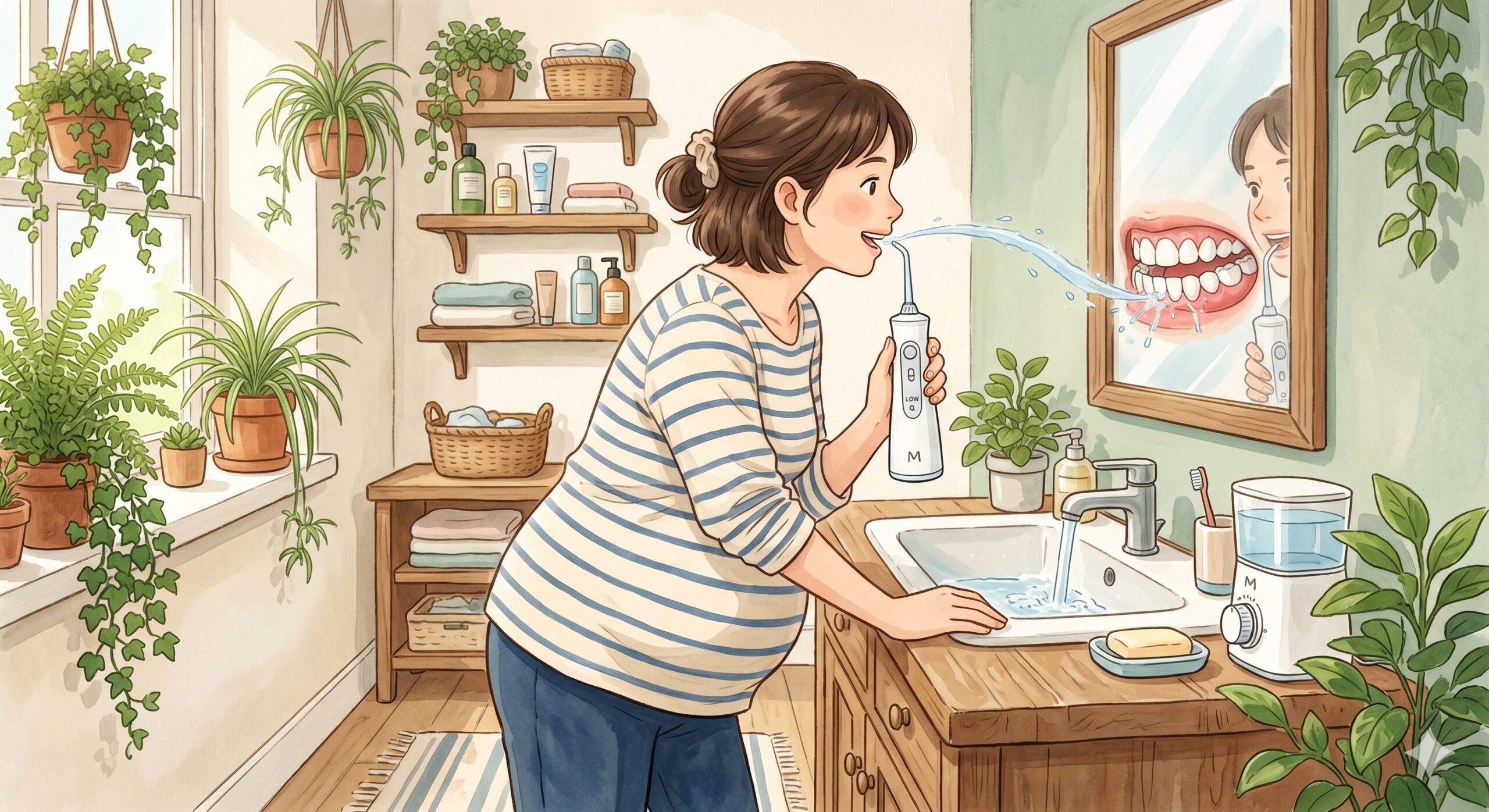
The worry that the jet "damages" gums comes almost entirely from using too high a pressure or aiming into the gum pocket. Used correctly, a water flosser is gentler on inflamed gums than aggressive string flossing. The American Dental Association accepts oral irrigators that meet its criteria for safety and plaque/gingivitis reduction, and a Cochrane review of interdental cleaning supports adding interdental tools to brushing. If you have advanced gum disease, recent oral surgery, or implants, check technique with your dentist first.
Mild gum tenderness and pinkish water for the first few days are normal when you start — that is existing inflammation flushing out, and it usually settles within about two weeks. If bleeding is heavy, or it has not improved after two weeks, get your gums checked rather than pushing on.
As the gums heal over two to three weeks of consistent daily use, the bleeding settles and the water runs clear. If bleeding is heavy, painful, or still present after a couple of weeks, that points to gum disease that needs assessing — book a gum check rather than pushing through.
"After a professional cleaning, the gums are clean but sometimes briefly tender. Patients often stop all interdental cleaning for a few days, thinking they are being careful — but this is actually when the plaque film starts rebuilding fastest. A water flosser at low pressure on the evening after a cleaning is gentle enough on tender gums and keeps that clean slate intact. That is the right moment to start a good habit, not to pause one."
Dr. Saurabh Shrivastava · BDS, MDS Prosthodontist, DCI A-04860
How to Use a Water Flosser Correctly
Lean over the basin, start on low, and aim the tip just above the gum line at about 90 degrees. Move slowly tooth by tooth, inside and out, for two to three minutes once a day. Keep your lips almost closed so the water runs into the basin rather than the mirror.

Fill the reservoir with lukewarm water and work along the outer then inner surfaces of the upper teeth, then the lower, pausing a second or two between each pair. Usually before brushing. Rinse the device and tip after each use. Use it daily — consistent low-to-medium pressure for two to three minutes is what delivers results.
What pressure to use: start on the lowest setting and build up — most people settle in the low-to-medium range; only healthy mouths with no sensitivity need high.
If the jet makes you flinch or the gum bleeds sharply, the pressure is too high — drop a level. Aim the tip just above the gum line, never straight into the pocket. Patients with sensitive teeth and gums almost always do better on low to begin with.
- Pressure too high to start. Begin on low; high pressure on tender gums causes the discomfort people blame on the device.
- Aiming into the gum, not above it. The jet should skim the gum line, not blast into the pocket.
- Using it instead of brushing. It is an addition — brushing removes the bonded film water can't.
- Leaning back instead of over the basin. Lean forward and close your lips loosely around the tip.
Who Benefits Most from a Water Flosser
A water flosser helps most where string floss is hardest to use — around braces, bridges, and implants, and for anyone with limited hand dexterity or early gum disease. People who have never managed to floss regularly often stick with it, which is where the real benefit comes from.

- Fixed orthodontic braces — Threading string floss under each archwire takes several minutes and many patients simply skip it. A water flosser tip reaches under the wire and between brackets in under three minutes without threading. Patients in braces who use a water flosser consistently show far less gum inflammation and fewer decalcification marks around brackets at debonding.
- Dental bridges — The underside of a bridge pontic (the false tooth spanning the gap) is impossible to clean with standard string floss without a specialised threader. A water flosser jet aimed under the pontic clears food debris and disrupts plaque in a space that otherwise goes uncleaned between professional visits.
- Dental implants — The collar of a dental implant where it meets the gum is a critical area. Peri-implantitis — the implant equivalent of gum disease — begins at this junction. A water flosser tip directed just below the gum margin around each implant, at low pressure, is one of the most effective tools for keeping this area clean long-term.
- Limited finger dexterity — Arthritis, tremors, or post-stroke hand weakness can make string flossing difficult to perform consistently. A water flosser requires only the ability to hold and aim a lightweight handle. For elderly patients or those with reduced dexterity, this often means the difference between cleaning happening and not happening.
- Early gum disease (gingivitis) — Patients with red, bleeding gums at a recall visit are often reluctant to floss because it hurts and bleeds. A water flosser at low pressure is gentler on inflamed tissue and still disrupts the plaque causing the inflammation. As the gums heal over two to three weeks of consistent use, the bleeding reduces, and patients become more willing to add string flossing back alongside it.
According to Dr. Saurabh Shrivastava, MDS Prosthodontist: "I recommend water flossers primarily to two groups of patients: those with braces or bridges where string floss is genuinely difficult to thread, and those with early gum disease who are motivated to improve their home care but struggle with consistent flossing technique. For these patients, a water flosser used correctly every day makes a measurable difference in gum health between professional cleaning visits — I can see it in their probing scores at the six-month recall."
| Patient | Female, 38, chartered accountant |
| Presenting issue | Generalised chronic gingivitis; bleeding on probing at 72% of sites, probing depths 3-4 mm |
| Treatment | Full-mouth ultrasonic scaling; nightly water flosser + string floss 3×/week home care |
| Six-week review | Bleeding on probing reduced to 18%; probing depths 2-3 mm throughout |
| Six-month review | No bleeding on probing; minimal deposits; healthy gum margins throughout |
Frequently Asked Questions
Is a water flosser good for teeth cleaning?
Yes, for most people. Used at a comfortable pressure with the tip above the gum line, a water flosser safely flushes food and soft plaque and is gentle on inflamed gums. It is an addition to brushing, not a replacement.
What are the side effects of a water flosser?
Mild gum tenderness and pinkish water in the basin for the first few days are normal as minor inflammation resolves, and they settle within about two weeks. Used at too high a pressure or aimed into the gum pocket it can cause discomfort — keep the pressure comfortable and the tip just above the gum line.
What water pressure should I use for teeth cleaning?
Start on the lowest setting. Sensitive or inflamed gums and the first week after a cleaning suit low pressure; braces, bridges, and implants suit medium; only healthy gums with no sensitivity need high. Drop a level if it stings or bleeds.
Can a water flosser remove tartar?
No. It flushes away food and soft plaque, but hardened tartar (calculus) bonded to the tooth must be removed by professional scaling at the clinic.
Can I use a water flosser the same day as a professional cleaning?
Yes — at a low to medium pressure setting. Wait a day if the gums feel particularly tender after the cleaning.
Does a water flosser replace string floss?
Not entirely. String floss scrapes the contact point between teeth; a water flosser flushes and reaches around appliances. Used together they are more effective than either alone.
How do I book a professional cleaning at Smile Gallery, Arera Colony?
Call +91 9200700750 to schedule a six-monthly professional cleaning at Smile Gallery Dental Wellness Centre, Arera Colony, Bhopal.
Ready for a consultation?
Visit Smile Gallery Dental Wellness Centre, E-4/205, Main Rd 3, near Flower Market, E-4, Arera Colony, Bhopal, Madhya Pradesh 462016.
Open Monday to Saturday 10am–2pm and 5–9pm.
