Common Tooth Problems in Children and How to Prevent Them
Expert guidance from Dr. Saurabh Shrivastava, BDS, MDS Prosthodontist, Certified Digital Smile Designer (DSD)
By Dr. Saurabh Shrivastava, BDS, MDS · April 2026 · 6 min read
Quick AnswerCommon tooth problems in children include early tooth decay, cavities, baby tooth issues, thumb-sucking damage, and gum irritation. Prevent them with fluoride toothpaste in age-appropriate amounts, daily flossing once teeth touch, limited sugar, weaning off night-time bottles, and six-monthly dental visits from age one.
Medically reviewed by Dr. Saurabh Shrivastava, BDS MDS Prosthodontist, Certified Digital Smile Designer (DSD) (DCI: A-04860). Last updated: May 2026.
Disclaimer: This content is for informational purposes and does not replace a personalised consultation. Every patient's dental condition is different. Please consult a qualified dentist for advice specific to your case.
The five most common tooth problems in children — early tooth decay, slowly building cavities, baby tooth complications, thumb-sucking-related changes to alignment, and gum irritation — are each prevented with the same handful of habits: fluoride toothpaste in age-appropriate amounts, daily flossing once teeth touch each other, limited sugar exposure, weaning off night-time bottles by age one, and six-monthly dental visits from the first tooth onwards. Dr. Kirti Shrivastava, BDS MDS PhD Prosthodontist (DCI: A-01281), Professor at Peoples Dental College Bhopal, applies this approach for paediatric patients at Smile Gallery Dental Wellness Centre, Arera Colony, with families coming from Awadhpuri and across the city. Catching small problems early avoids the more involved dental treatment that follows neglected decay; even where paediatric pulp therapy becomes necessary, outcomes are similar to adult root canal therapy, which has a 95% success rate over 10 years.
The Most Common Tooth Problems in Children
Early Tooth Decay
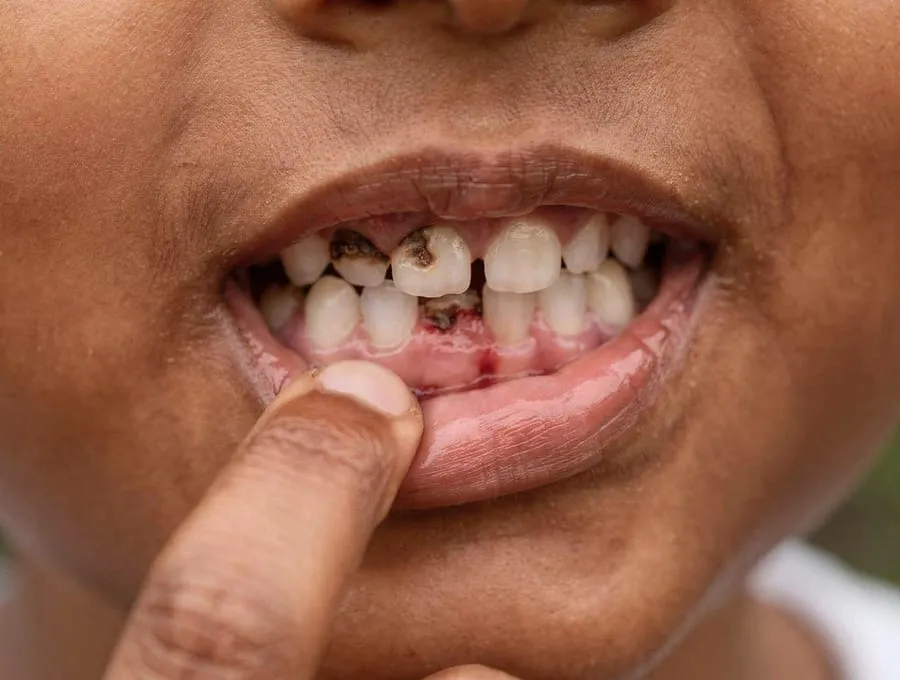
The earliest sign is a chalky white line along the gum margin of the upper front teeth. This progresses to brown or black spots, then to visible holes. Caught at the chalky-white stage, fluoride application alone often reverses it.
Cavities That Build Quietly
Cavities between teeth often cause no pain until close to the pulp. Six-monthly check-ups catch these on examination and X-rays before they cause trouble.
Baby Tooth Complications
Lost baby teeth from severe decay or trauma cause spacing problems for the permanent teeth that follow. A space maintainer holds the gap until the permanent tooth is ready.
Thumb-Sucking and Habit-Driven Changes
Pacifier use beyond age four can shift the front teeth and the bite. Gentle, positive guidance — never shame — usually works best.
Gum Irritation
Red, puffy, or bleeding gums in children usually mean plaque is not being removed thoroughly. The fix is gentler, more thorough brushing supervised by a parent.
Good Daily Care at Home
Brush twice a day for two minutes with a soft brush and a smear of fluoride toothpaste under age three (pea-sized from age three). Help the child until they can brush properly alone (usually around age seven or eight). Floss any teeth that touch each other. Limit sweets to mealtimes. Encourage water rather than juice between meals.
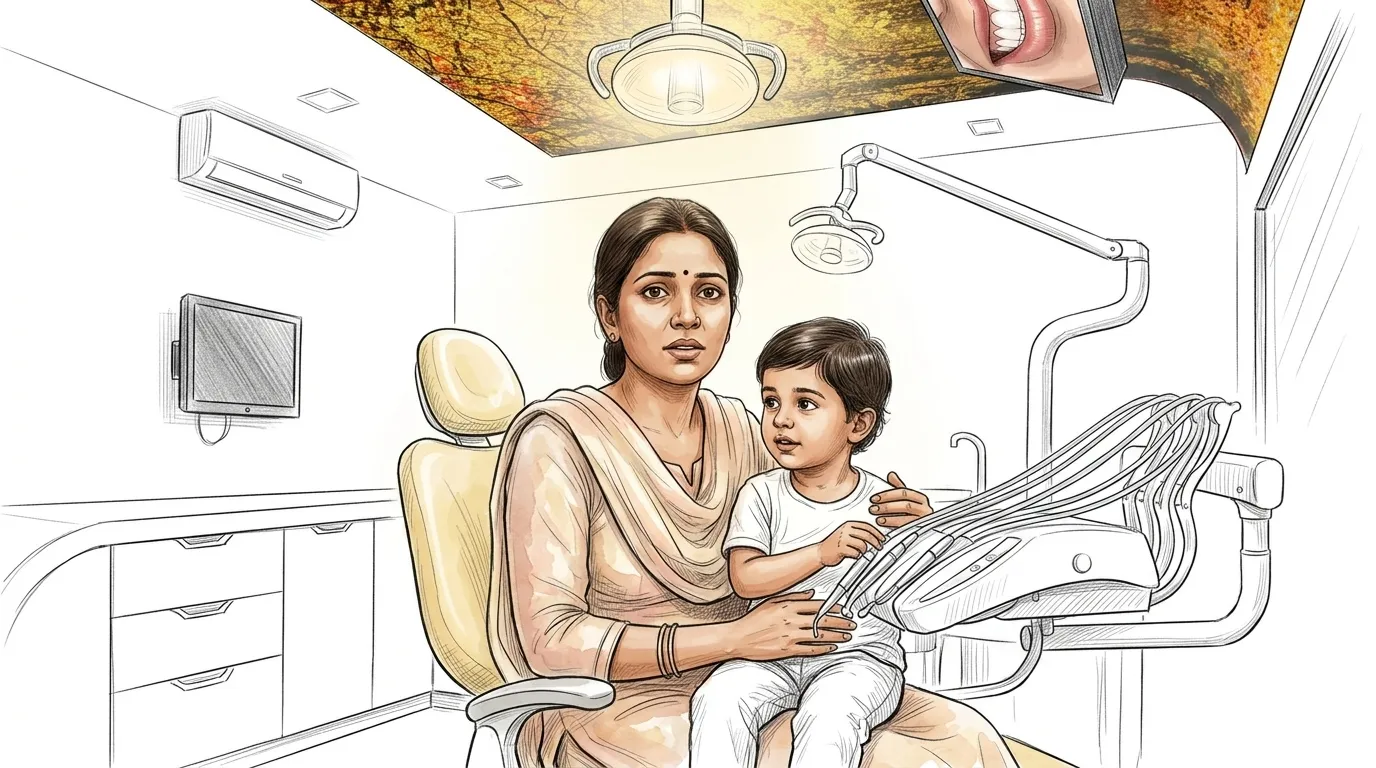
Clinical environment at Smile Gallery — kids dental care care, Arera Colony, Bhopal
According to Dr. Saurabh Shrivastava, MDS Prosthodontist: "The chalky-white line along the gum margin of the upper front teeth is the single most important early sign parents should know — at that stage, fluoride application alone can reverse the decay without any drilling. By the time a brown spot appears, we are already restoring rather than reversing."
Professional Cleanings for Kids — Are They Necessary?
Yes. Baby teeth guide adult teeth into the right position, support speech and chewing, and serve as the foundation for lifelong oral habits. A child’s cleaning takes 20 to 30 minutes. Start by age one, then six-monthly.
"Parents often tell me their child's baby tooth will fall out anyway, so why treat it. But a healthy baby tooth in the right place for the right number of years is what guides the permanent tooth into position. Losing it two or three years early is not inconsequential — it is the start of a spacing problem."
Dr. Saurabh Shrivastava · BDS, MDS Prosthodontist, DCI A-04860
When Kids Need Root Canal (Pulpotomy or Pulpectomy)
Children sometimes need a root canal when decay or trauma reaches the pulp. Saving the baby tooth matters because it guides the permanent tooth into place. Most paediatric pulp procedures complete in a single45 to 60 minute visit.
Five Things Every Parent Should Know About Kids Dental Care
Small habits established early make the biggest difference to a child's dental future.
Start before the first birthday — the first dental visit should happen by age one or within six months of the first tooth erupting. Early visits build familiarity with the clinic environment and catch problems at their smallest.
Fluoride toothpaste is safe and essential — use a smear (grain-of-rice size) for children under three, a pea-sized amount from age three onwards. Fluoride remineralises early enamel lesions before they become cavities requiring a filling.
Night-time bottles cause the worst decay — milk and juice pooling around teeth during sleep fuel the bacteria that cause early childhood caries. Water is the only safe bedtime bottle beyond six months.
Supervise brushing until age seven or eight — children lack the fine motor coordination to clean all tooth surfaces properly until around age seven. A parent completing the second brush of the day takes two minutes and prevents years of treatment.
Thumb-sucking needs gentle redirection, not pressure — habit appliances are available if the behaviour persists past age four, but shame and punishment make children anxious about their mouths, which creates a different problem altogether.
The Long Game — Building Lifetime Habits
Habits established before age six tend to stay. Twice-daily brushing with parental supervision until age seven or eight, daily flossing, water as the default drink, and a friendly six-monthly visit make decay much less likely as your child grows.
According to Dr. Saurabh Shrivastava, MDS Prosthodontist: "Baby teeth are not temporary problems — a prematurely lost lower molar can collapse the space for the permanent tooth that follows, making orthodontic correction necessary years later. A space maintainer fitted on the day of extraction costs a fraction of the braces treatment it prevents."
Names and identifying details changed for privacy.
Illustration for patient privacy — identifying details altered.
The clinical case and outcome are from Dr. Saurabh Shrivastava's practice.
Meena brought her son Arjun in on a Saturday afternoon in January, having spotted something she could not ignore any longer. She was 34, a primary school teacher in Govindpura, and Arjun was 5. "He has been waking up at night saying his tooth hurts," she said. "I looked and saw a black hole. I feel terrible — I thought milk teeth didn't matter much."
The examination showed advanced decay on the lower left first baby molar — the cavity had reached the pulp. There were also 2 early cavities on the upper front teeth at the chalky-white stage, and generalised plaque along the gum margins indicating inadequate brushing. Arjun had been falling asleep with a milk bottle most nights since infancy, a habit that had continued even at age 5.
I explained the situation to Meena carefully. The lower molar needed a pulpotomy — the paediatric equivalent of a root canal, where the infected pulp tissue is removed and the tooth is sealed with a stainless steel crown to hold it in place until the permanent tooth was ready to come through, which would not happen for another 5 to 6 years. The upper front lesions, caught early, needed only fluoride varnish and monitoring.
"Will it hurt him?" Meena asked.
"We use topical anaesthetic before the injection so he should not feel the needle. Children this age usually surprise their parents — they are often calmer in the chair than the parent in the waiting room." Arjun, to his credit, sat through the entire procedure without complaint. The pulpotomy and stainless steel crown took 50 minutes. He left the clinic asking for lunch.
I gave Meena a clear home-care plan. Switch Arjun to a soft-bristled child's brush and kids dental care fluoride toothpaste, pea-sized amount, twice daily. Stop the night bottle immediately — water only in the evenings. Meena was to brush Arjun's teeth herself at night until he turned 8. No biscuits or juice between meals on school days. Fluoride varnish application every 3 months for the next year to protect the upper front teeth.
At the follow-up4 weeks later, the pulpotomy site was healing well. The stainless steel crown was intact and Arjun had stopped waking with toothache. The 2 upper front lesions had not progressed — the chalky areas were slightly more opaque, suggesting early remineralisation from the fluoride varnish. Meena had stopped the bedtime bottle entirely and was brushing Arjun's teeth herself every evening.
"He actually asks me to brush his teeth now," she said. "I think he likes the toothpaste flavour. I wish I had started all this earlier."
At the 6-month check-up, no new cavities. The upper front enamel lesions had fully remineralised. Arjun had also started his first year of school and was reportedly telling his classmates that the dentist was "not scary at all." We scheduled six-monthly reviews and sealants for his first permanent molars when they erupted.
Fully remineralised with fluoride varnish — no filling needed
Night-time bottle habit
Stopped within 2 weeks of advice
Ongoing care
6-monthly check-ups + fluoride varnish, sealants when permanent molars erupt
Related from Dr. Saurabh's Practice
Complete Range of Dental Services
Dental Implants at Smile Gallery
Preventive Dentistry for All Ages Adapting Dental Check Ups Throughout Life Stages
Braces at Smile Gallery
Explore the best of Dental Services in Bhopal With Smile Gallery
Dental Implants at Smile Gallery
Frequently Asked Questions
What does paediatric dental treatment include?
Examination, gentle cleaning, fluoride application, sealants, fillings where needed, paediatric crowns, pulp therapy when decay reaches the pulp, and orthodontic screening from age seven.
Are paediatric services available at Smile Gallery in Bhopal?
Yes. Smile Gallery, in Arera Colony, sees young children and teenagers under Dr. Kirti Shrivastava (DCI: A-01281), Professor at Peoples Dental College Bhopal.
How long does a paediatric visit take?
20 to 30 minutes for routine visits; 45 to 60 minutes for treatment visits.
What should we expect after a paediatric visit?
A written plan, brushing recommendations, and a six-monthly review schedule.
How do we book a paediatric appointment at Smile Gallery, Arera Colony?
BDS, MDS Prosthodontist, Certified Digital Smile Designer (DSD)
15+ years of clinical practice | Smile Gallery Dental Wellness Centre, Bhopal
DCI: A-04860 · IPS-OL1204 · ISOI-Ac/L/3187/MP · ISMR Member
Ready for a consultation?
Visit Smile Gallery Dental Wellness Centre, E-4/205, Main Rd 3, near Flower Market, E-4, Arera Colony, Bhopal.
Open Monday to Saturday 10am–2pm and 5–9pm.
Call +91 9200700750
At Smile Gallery Dental Wellness Centre,we understand that there is no such thing as a perfect smile but a smile that is perfect for each of our patients. Check us out now!