
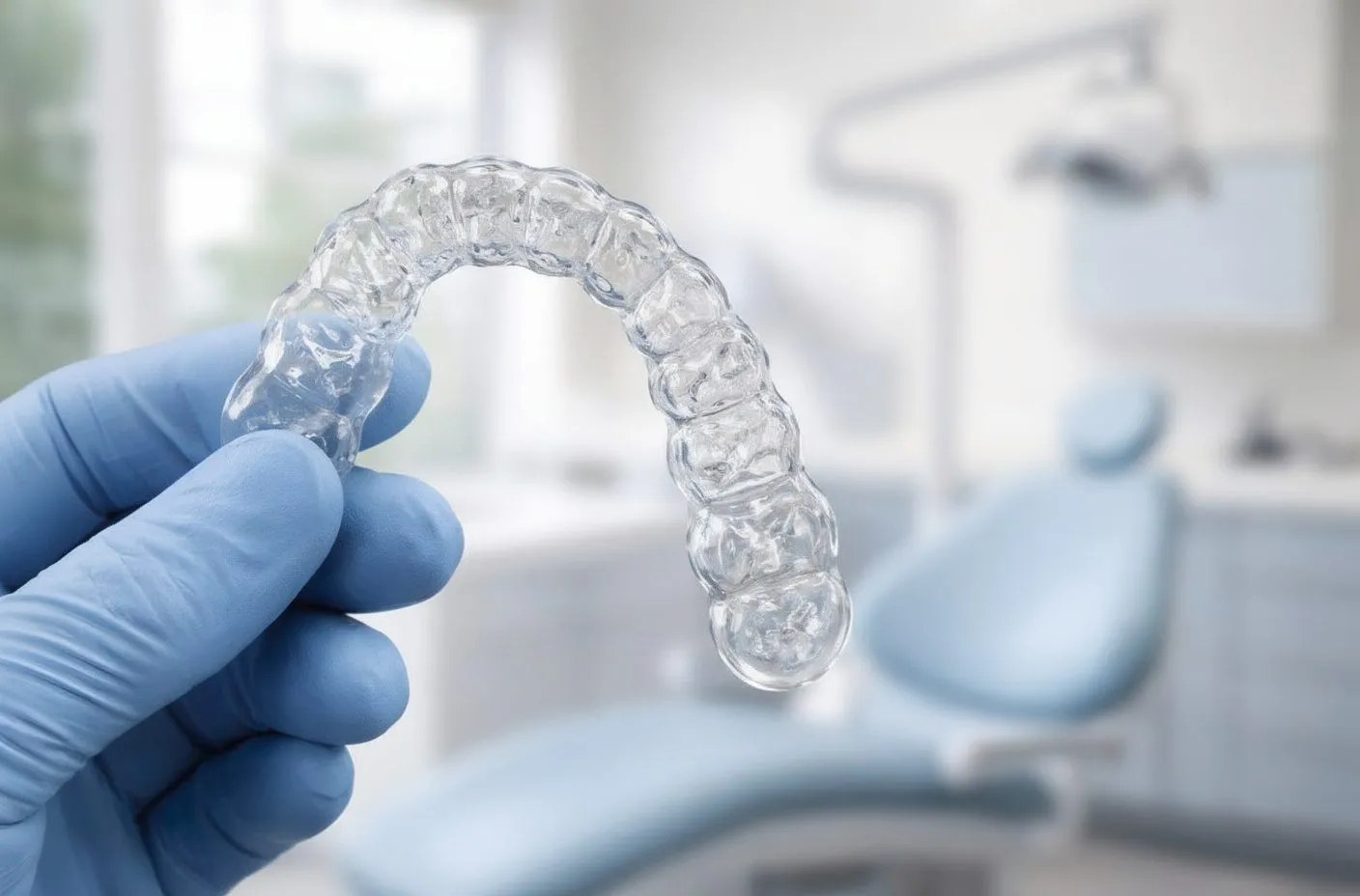
Invisible aligners in Bhopal are clear, custom-made trays that gradually move teeth into position. They are nearly invisible, removable for meals, and comfortable. Most cases run 12 to 24 months — within the typical 18 to 24 month window of braces treatment.
Medically reviewed by Dr. Kirti Shrivastava, BDS MDS, PhD Prosthodontist (DCI: A-01281). Last updated: May 2026.
Invisible aligners are clear, custom-made trays that gradually move teeth into the planned position; they are nearly unseen at conversation distance, removable for meals and brushing, comfortable to wear, and effective for most mild to moderate alignment cases — completing within 12 to 24 months, which sits inside the typical 18 to 24 month window of braces treatment. Dr. Kirti Shrivastava, BDS MDS PhD Prosthodontist (DCI: A-01281), Professor at Peoples Dental College Bhopal, plans aligner cases digitally at Smile Gallery Dental Wellness Centre, Arera Colony.
Can I align my teeth without braces?
Yes, many people can. Clear aligners are thin, removable trays that move teeth a little at a time. They work well for mild to moderate crowding or gaps. Severe bite problems usually still need braces. Veneers can make slightly uneven teeth look straight without moving them. At Smile Gallery, Bhopal, an examination shows which option suits you.
How Invisible Aligners in Bhopal Work
Invisible aligners are made from medical-grade clear plastic, custom-fitted to the teeth based on a digital scan. Each tray is worn for one to two weeks before being changed for the next, with each pair shifting the teeth a fraction of a millimetre closer to the planned end position. The full sequence — usually 20 to 40 trays for a complete case — is designed digitally before treatment begins, so patients and parents preview the final result before fitting the very first tray.
Benefits Over Traditional Braces
Aligners are nearly invisible at conversation distance, so there is no self-consciousness during work or social events. They are removable, so meals stay normal — no foods to avoid, no awkward chewing around brackets and wires. Brushing and flossing happen exactly as before. There are no emergency visits for poking wires or broken brackets. The smooth plastic is comfortable against the cheeks, lips, and tongue.
According to Dr. Kirti Shrivastava, MDS, PhD Prosthodontist: "The most common reason adults in Bhopal avoid orthodontic treatment is the visibility of metal brackets — they do not want to be seen wearing braces at work or at social occasions. Invisible aligners remove that barrier entirely; most patients tell me their colleagues did not notice the treatment until the final result."
Cases Where Aligners Are a Good Fit
Aligners work well for crowding, mild rotation, spacing between teeth, mild overbites and underbites, and many open bites. They are particularly suited to adults and disciplined teenagers who can wear the trays 20 to 22 hours a day reliably. Aligners are a strong option for relapse cases — patients who had braces years ago and now show some movement back.
"Digital planning changes the patient's relationship with orthodontic treatment. When I show someone an animation of where their teeth will be at the end of treatment before we have fitted even the first tray, they stop thinking about the process and start thinking about the result. That shift in focus makes compliance much better."
Dr. Kirti Shrivastava · BDS, MDS, PhD Prosthodontist, IPS-OL2283
Cases Where Fixed Braces Still Work Better
Severe rotations, large skeletal mismatches between upper and lower jaws, very young growing patients, and certain complex movements are still better managed with fixed braces. The orthodontist makes this decision after a clinical exam, photographs, and X-rays — not based on patient preference alone, since starting a treatment that cannot succeed is unfair to the patient.
- Wear time is non-negotiable — aligners must be worn 20 to 22 hours a day to move teeth on schedule. Taking them out for more than 2 hours a day allows teeth to drift back, extends treatment, and wastes trays already manufactured to a plan that is no longer accurate.
- Not every case is suitable — severe skeletal mismatches, complex rotations, and very young growing patients are better managed with fixed braces. An honest assessment after X-rays and photographs determines suitability; a good orthodontist will tell you if aligners are not the right choice for your case.
- You will preview the end result before treatment begins — digital planning produces a simulation showing tooth position at every stage from start to finish. This is reviewed and agreed upon together before the first tray is dispensed.
- Review visits are shorter but still essential — aligner appointments are typically 20 to 30 minutes every 6 to 10 weeks, but skipping them allows small tracking errors to accumulate. The orthodontist checks that the teeth are following the planned path and adjusts if needed.
- Retainers are lifelong — most patients use a fixed lingual retainer (a thin wire bonded behind the front teeth) plus a removable retainer worn overnight indefinitely. Stopping retention after a year means the movement you paid for slowly reverses.
The Aligner Treatment Journey at Smile Gallery
The journey begins with a consultation, photographs, intra-oral digital scan, and panoramic X-ray. The orthodontist plans the case digitally, shares a previewable end-result animation, and dispenses the first set of trays. Review visits happen every six to ten weeks; trays are switched at home according to the schedule. After active treatment, retainers are essential to keep the result.
Care, Maintenance, and Retainers After Treatment
Wear each tray 20 to 22 hours a day. Take them out only for meals, drinks other than water, and brushing. Clean the trays with cool water and a soft brush each morning and evening. After active treatment finishes, fixed or removable retainers prevent teeth from drifting back. Without retainers, teeth shift over the years no matter how carefully alignment was done.
According to Dr. Kirti Shrivastava, MDS, PhD Prosthodontist: "Retainers after aligner treatment are not optional — teeth have a biological memory and will drift back toward their original position over months and years without retention. I always tell patients that the retainer phase is as important as the aligner phase; the alignment we achieved together is worth protecting for life."
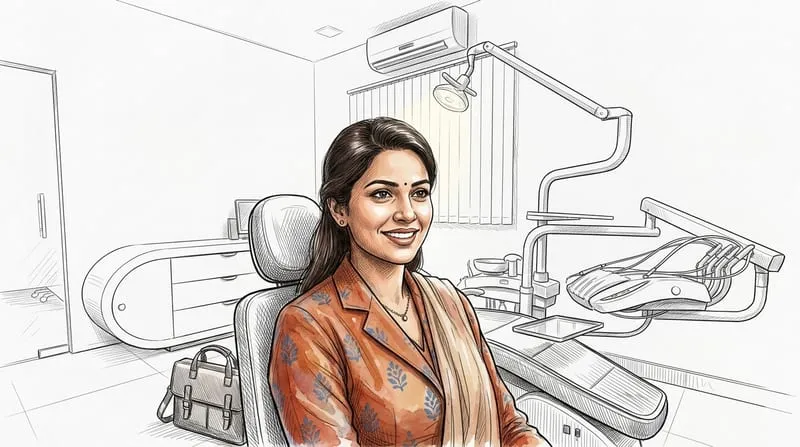
The clinical case and outcome are from Dr. Kirti Shrivastava's practice.
Divya came in on a Saturday morning in February, referred by a colleague who had completed aligner treatment at the clinic the previous year. She was 29, a software professional working from an office in TT Nagar, and she had been self-conscious about her crowded upper front teeth since her teens. She had avoided metal braces as an adult on the basis that she presented to clients weekly and could not face the questions.
"I want the invisible ones," she said. "I've researched this quite a bit. But I want to understand if my teeth are actually fixable with aligners, because I've read they don't work for every case."
The clinical examination showed moderate crowding on the upper arch — the upper right lateral incisor was palatally displaced by approximately 4 mm and the upper left canine was slightly rotated. The lower arch had mild crowding. The panoramic X-ray confirmed no skeletal discrepancy and healthy bone levels. The case was well within the range that invisible aligners Bhopal patients typically achieve excellent results with.
The intra-oral scan took 8 minutes. The digital plan was ready within a week. I called Divya in to review the animation — 26 trays over approximately 14 months, showing each stage of tooth movement, ending with a final position that resolved all of the crowding. She watched the animation twice and asked one question: "Can we start this week?"
The first tray was fitted on the following Thursday. I showed her how to insert and remove the aligners without bending them, reviewed the wear schedule, and explained exactly when to switch trays. She was to change trays every 10 days at home according to the plan. The first review appointment was scheduled at 8 weeks.
At 8 weeks she was on tray 6, tracking well. The palatally displaced lateral incisor had already started to move into the arch — visible movement that she had photographed on her phone and shared with her mother. "My colleagues still haven't noticed," she said, which was exactly what she had hoped for. Her wear compliance was excellent — she had worn the trays for the full 22 hours on all but 3 days when she had attended evening events.
At month nine, tray 19 of 26, the upper arch crowding was substantially resolved. 3 refinement trays were added to the plan after a mid-course scan to fully correct the canine rotation — a routine adjustment that does not extend the overall timeline significantly. The fixed lingual retainer was bonded behind the upper front teeth at the end of active treatment, and a removable retainer was delivered for overnight wear.
"I actually smiled in a client presentation last month," she said at her final appointment. "I mean, properly smiled — not the closed-mouth version I've been doing for ten years."
At the 6-month retention check, teeth were stable. The lingual retainer was intact. She was wearing the overnight retainer consistently. She had also recommended the clinic to 2 colleagues, both of whom had booked consultations.
BDS, MDS, PhD Prosthodontist · DCI A-01281 · Smile Gallery, Bhopal
| Follow-up | 6 months post-retention |
| Active treatment | 26 trays + 3 refinements, completed in 16 months |
| Crowding | Fully resolved — lateral incisor and canine aligned |
| Retention | Fixed lingual retainer intact, overnight retainer worn consistently |
| Ongoing care | Annual retention check, 6-monthly general dental review |
Frequently Asked Questions
What does invisible aligner treatment involve?
A digital scan, a digital plan with a previewable end result, a sequence of clear trays worn 20 to 22 hours a day, review visits every six to ten weeks, and retainers afterwards.
Are invisible aligners available at Smile Gallery in Bhopal?
Yes. Smile Gallery, in Arera Colony, offers digitally planned aligner treatment under Dr. Kirti Shrivastava (DCI: A-01281), Professor at Peoples Dental College Bhopal.
How long does aligner treatment take?
Most cases run 12 to 24 months. Mild cases may finish sooner; complex cases longer.
What should I expect after starting aligners?
Mild pressure for the first one to two days of each new tray. Speech adjusts within a day. Eat with trays out and brush before reinserting them.
How do I book an aligner consultation at Smile Gallery, Arera Colony?
Call +91 9200700750.
Ready for a consultation?
Visit Smile Gallery Dental Wellness Centre, E-4/205, Main Rd 3, near Flower Market, E-4, Arera Colony, Bhopal.
Open Monday to Saturday 10am–2pm and 5–9pm.
