

Ten simple steps protect oral health: brush twice daily, floss daily, use fluoride toothpaste, clean your tongue, replace your brush every three months, eat a balanced diet, avoid tobacco, drink water, limit sugar, and visit your dentist every six months.
Medically reviewed by Dr. Saurabh Shrivastava, BDS MDS Prosthodontist (DCI: A-04860). Last updated: May 2026.
- 1. Brush Twice a Day
- 2. Floss Every Day
- 3. Use Fluoride Toothpaste
- 4. Clean Your Tongue
- 5. Replace Your Toothbrush Regularly
- 6. Eat a Balanced Diet
- 7. Avoid Tobacco and Limit Alcohol
- 8. Drink Water and Limit Sugary Drinks
- 9. Wear a Mouthguard When Needed
- 10. Visit Your Dentist Every Six Months
- Frequently Asked Questions
Ten simple habits — twice-daily brushing, daily flossing, fluoride toothpaste, tongue cleaning, regular brush replacement, a balanced diet, avoiding tobacco, drinking water, limiting sugar, and a six-monthly dental check-up — together do more for oral health than any single treatment, and they form the foundation of every patient’s care plan at Smile Gallery Dental Wellness Centre, Arera Colony, under Dr. Saurabh Shrivastava, BDS MDS Prosthodontist (DCI: A-04860). Patients from BHEL and surrounding areas often arrive after years of irregular care; once these habits are established, the difference at the next check-up is visible. When prevention falters and decay reaches the pulp, root canal professional teeth cleaning has a 95% success rate over 10 years, but prevention is always less costly and less invasive.
1. Brush Twice a Day
Brush in the morning and before bed. Use gentle, circular strokes for two minutes, holding the brush at a 45-degree angle to the gum line. Hard horizontal scrubbing damages enamel and gums over time and leads to sensitivity.
2. Floss Every Day
Brushing cleans only three of the five surfaces of each tooth. Daily flossing reaches the contact points between teeth where decay and gum disease usually start. Interdental brushes work well for adults with wider gaps or bridges.
According to Dr. Saurabh Shrivastava, MDS Prosthodontist: "Oral health deteriorates fastest between ages 30 and 45 because most adults stop flossing once they leave home, and plaque hardens into calculus within 48 hours of forming. A six-monthly scaling reverses years of silent buildup before it reaches the bone."
3. Use Fluoride Toothpaste
Fluoride strengthens enamel and reverses very early decay before a cavity forms. Children below six should use a pea-sized amount under supervision; adults should ensure their toothpaste lists fluoride as an active ingredient.
"I have seen patients walk in after 8 years without a cleaning, expecting the worst, and walk out needing only a scaling and two small fillings. The mouth is forgiving if you catch things early — but it keeps a strict ledger if you do not."
Dr. Saurabh Shrivastava · BDS, MDS Prosthodontist, DCI A-04860
4. Clean Your Tongue
The tongue harbours bacteria that cause bad breath and reinfect freshly cleaned teeth. A soft tongue scraper or the back of your toothbrush, used gently from back to front, takes only a few seconds.
5. Replace Your Toothbrush Regularly
Replace a manual brush or electric brush head every three months, or sooner if the bristles are splayed. After any cold, flu, or throat infection, replace the brush to avoid reinfection.
According to Dr. Saurabh Shrivastava, MDS Prosthodontist: "Fluoride toothpaste is the single most cost-effective oral health intervention because it remineralises early enamel lesions before they become cavities — a tube of fluoride paste prevents damage that would otherwise require a filling costing 50 times more."
6. Eat a Balanced Diet
Calcium, vitamin D, vitamin C, and phosphorus all play a role in healthy teeth and gums. Include dairy or fortified alternatives, leafy greens, fish, eggs, and fresh fruit. Crunchy raw vegetables also help mechanically clean tooth surfaces.
7. Avoid Tobacco and Limit Alcohol
Tobacco in any form — cigarettes, gutka, paan masala — stains teeth, causes gum recession, and is the single biggest risk factor for oral cancer. Heavy alcohol use dries the mouth, reducing the saliva that protects teeth.
- No fasting required — eat normally before your appointment, but avoid heavy meals right before if you tend to gag during examination.
- Scaling is not harmful — professional cleaning removes hardened deposits that brushing cannot reach. Enamel is not damaged by the ultrasonic scaler; the vibrations target calculus, not tooth structure.
- Sensitivity after cleaning is temporary — mild cold sensitivity settles within 5 to 7 days as gums reattach to freshly cleaned root surfaces.
- X-rays are not always needed — your dentist will take an OPG only when a clinical finding requires confirmation. Routine check-ups often need no imaging at all.
- Brush replacement matters more than brand — any soft-bristled brush replaced every 3 months outperforms an expensive brush used for a year.
- Know your alternatives — if you dislike string floss, interdental brushes or a water flosser achieve similar plaque removal between teeth, with slightly better results around bridges and implants.
8. Drink Water and Limit Sugary Drinks
Water rinses food particles, neutralises acid, and supports saliva production. Sugary and fizzy drinks coat teeth in fermentable sugars; if you do drink them, use a straw and rinse with water afterwards.
9. Wear a Mouthguard When Needed
If you grind your teeth at night or play contact sports, a custom-fit mouthguard from your dentist protects enamel, prevents fractures, and eases the morning jaw pain that comes with long-term grinding.
10. Visit Your Dentist Every Six Months
Professional cleaning removes the hardened deposits that brushing cannot. Six-monthly check-ups also catch early decay, gum problems, and bite issues while they are still simple to treat.
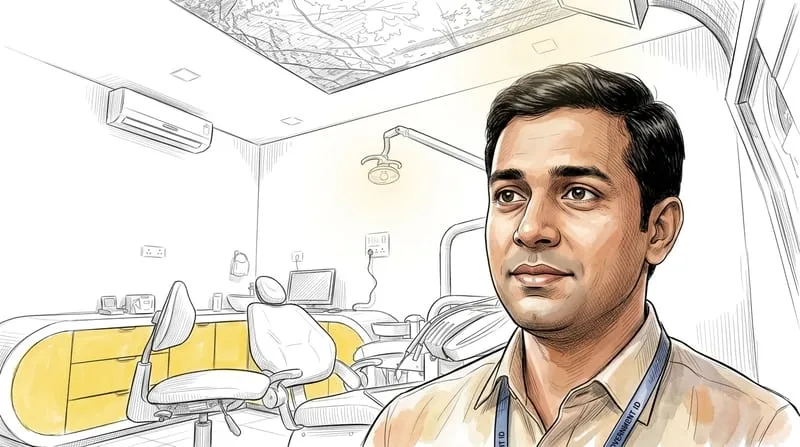
The clinical case and outcome are from Dr. Saurabh Shrivastava's practice.
Vikram came in on a Wednesday morning in November, still in office formals, his government ID card swinging from a lanyard. He was 36, worked in the finance department at Vallabh Bhavan, and had not seen a dentist since his pre-employment medical 7 years earlier.
"My wife said my breath is bad," he said, looking more embarrassed than concerned. "And my gums bleed when I brush. I kept putting off the appointment."
The examination showed the predictable picture of long-deferred care. Heavy calculus along the lower anterior lingual surfaces, generalised marginal gingivitis with bleeding on probing at 9 of 12 sites, and 3 early cavities — one on a lower molar, two small interproximal lesions in the upper premolars. His oral health had drifted quietly for years while he had been busy with transfers and appraisals.
When I asked about his routine, the story was familiar. He brushed once — in the morning, medium-bristled brush, a vigorous horizontal scrub that was actually abrasive rather than effective. He drank 4 cups of tea with sugar daily, ate lunch from the government canteen, and snacked on namkeen and biscuits through the afternoon. He had never flossed and had no idea what interdental brushes were.
I kept the explanation practical. "The bad breath is the calculus — bacteria living in the deposits. Once we scale it off and you maintain it at home, it will resolve within 2 weeks. The cavities are small — I can fill all 3 in one sitting. But this only stays fixed if the habits change."
We did the full-mouth scaling that morning — 40 minutes. Vikram had significant subgingival calculus on the lower anteriors that required more time, but he tolerated it well. We filled all 3 cavities with tooth-coloured composite in the same appointment. He left with a soft-bristled brush, a box of interdental picks, and instructions to cut the tea from 4 cups to 2.
He came back at 3 weeks. The bleeding had stopped at all but 2 sites, and his wife had confirmed the breath had improved within the first week. He had switched to a soft brush and started using the interdental picks — not daily yet, but 4 to 5 times a week.
"I had no idea the gums could recover this fast," he said. "I thought once they bled it meant something was permanently wrong."
At his 6-month check-up, all probing sites were within normal limits. No new cavities. The 3 fillings were intact. He had brought his younger brother along — who had been avoiding the dentist for similar reasons — and both left with appointments booked for the following month.
BDS, MDS Prosthodontist · DCI A-04860 · Smile Gallery, Bhopal
| Follow-up | 12 months later |
| Gum bleeding | Resolved completely by day 4 post-scaling |
| Cavities | 2 composite fillings intact, no new decay |
| Calculus | None at 6-month and 12-month check-ups |
| Ongoing care | 6-monthly scaling + annual check-up |
Frequently Asked Questions
What do these 10 habits actually prevent?
Together they reduce the risk of cavities, gum disease, bad breath, sensitivity, tooth fracture, and tooth loss across a lifetime.
Are dental check-ups available at Smile Gallery in Bhopal?
Yes. Smile Gallery, located in Arera Colony, offers six-monthly check-ups and professional cleaning, with appointments easily booked from BHEL and other Bhopal localities.
How long does a routine check-up and cleaning take?
Around 30 to 45 minutes for adults — a clinical exam, scaling, polishing, and a brief discussion of any findings.What should I expect after my first cleaning visit?
Mild gum tenderness for a day is normal, especially if there has been long-standing tartar. Sensitivity to cold settles within a week.
How do I book an appointment at Smile Gallery, Arera Colony?
Call +91 9200700750 to schedule a routine check-up. Whole-family slots can be arranged together to make visits easier.
Ready for a consultation?
Visit Smile Gallery Dental Wellness Centre, E-4/205, Main Rd 3, near Flower Market, E-4, Arera Colony, Bhopal.
Open Monday to Saturday 10am–2pm and 5–9pm.