


Ten questions to ask your dentist: how to improve home oral hygiene, X-ray frequency, oral care during pregnancy, signs of oral cancer, how to maintain whitening, gum disease risk, treatment for sensitive teeth, brushing and flossing technique, when to see a specialist, and how often to visit.
Medically reviewed by Dr. Saurabh Shrivastava, BDS MDS Prosthodontist, Certified Digital Smile Designer (DSD) (DCI: A-04860). Last updated: May 2026.
- 1. How Can I Improve My Oral Hygiene at Home?
- 2. Do I Need X-Rays, and How Often?
- 3. How Can I Maintain Oral Health During Pregnancy?
- 4. Are There Signs of Oral Cancer I Should Watch For?
- 5. How Can I Keep My Teeth Whiter for Longer?
- 6. What Is My Risk for Gum Disease?
- 7. What Are My Options for Sensitive Teeth?
- 8. What Is the Right Way to Brush and Floss?
- 9. When Should I See a Specialist?
- 10. How Often Should I Visit the Dentist?
- Frequently Asked Questions
Ten common questions to ask your dentist — how to improve home oral hygiene, X-ray frequency, oral care during pregnancy, signs of oral cancer, how to maintain whitening, gum disease risk and prevention, treatment options for sensitive teeth, the right brushing and flossing technique, when to see a specialist, and how often to visit — together cover the practical knowledge most adults benefit from carrying away from a dental visit. Dr. Saurabh Shrivastava, BDS MDS Prosthodontist (DCI: A-04860) at Smile Gallery Dental Wellness Centre, Arera Colony, encourages these questions during routine professional teeth cleaning consultations for patients from Kolar Road and across Bhopal. Root canal therapy has a 95% success rate over 10 years when patients understand their care, not just receive it.
1. How Can I Improve My Oral Hygiene at Home?
The dentist will recommend specific changes based on your mouth — switching to a soft brush, using interdental brushes, adding a fluoride mouthwash, or changing technique at the gum line.
2. Do I Need X-Rays, and How Often?
For a healthy adult with no recent cavities, bitewing X-rays every one to two years are typical. Pregnant patients defer non-essential imaging where possible.
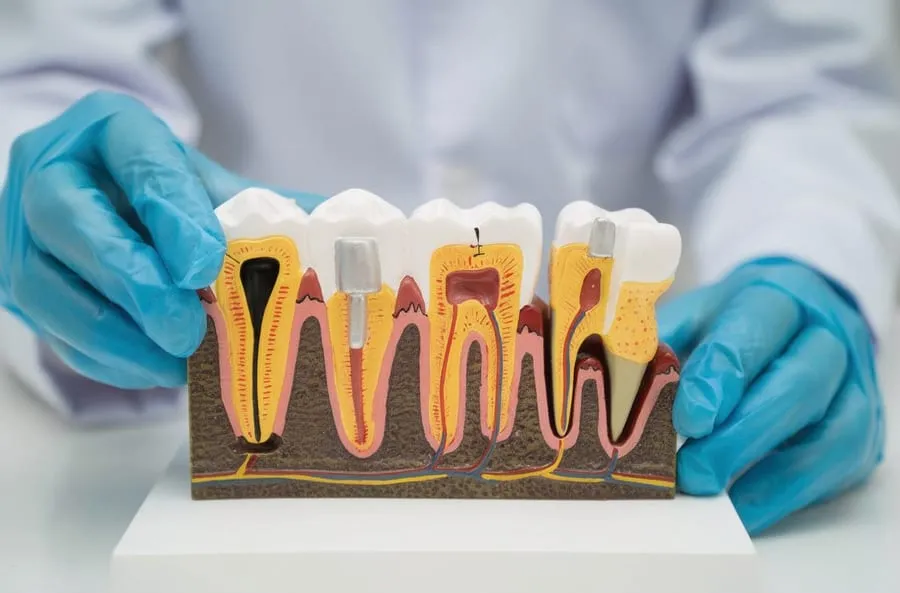
According to Dr. Saurabh Shrivastava, MDS Prosthodontist: "Patients who ask questions during a dental visit retain the information better and follow through on treatment more consistently — an informed patient is a cooperating patient. The ten minutes spent explaining a diagnosis and answering questions at the chair saves us multiple missed appointments and incomplete treatments later."
3. How Can I Maintain Oral Health During Pregnancy?
Maintain twice-daily brushing, daily flossing, and a six-monthly check-up. Tell the dentist you are pregnant so non-essential imaging is deferred.
"A patient who walks out of a dental appointment knowing what was found, what it means, what is being done about it, and what they need to do at home — that patient has received real care. Information is part of treatment, not a courtesy attached to it."
Dr. Saurabh Shrivastava · BDS, MDS Prosthodontist, DCI A-04860
4. Are There Signs of Oral Cancer I Should Watch For?
Persistent ulcers that do not heal in three weeks, white or red patches, lumps in the mouth or neck, and any unexplained numbness should be checked.
5. How Can I Keep My Teeth Whiter for Longer?
Rinse with water after coffee, tea, or red wine. Touch-up trays at home every six to twelve months extend professional whitening results. Whitening lasts 1 to 3 years on average.
According to Dr. Saurabh Shrivastava, MDS Prosthodontist: "The question most patients forget to ask — but benefit most from answering — is 'when should I see a specialist?' Prosthodontists, orthodontists, endodontists, and periodontists each solve problems that fall outside routine general dentistry scope; your general dentist should tell you clearly when a case needs specialist input rather than managing it beyond their comfort level."
6. What Is My Risk for Gum Disease?
Family history, smoking, diabetes, hormonal changes, and incomplete daily cleaning all raise risk. The dentist measures gum pockets and bleeding on probing during the check-up.
7. What Are My Options for Sensitive Teeth?
Use a desensitising toothpaste with potassium nitrate or stannous fluoride for at least four weeks. Identify and treat any underlying cause.
- Can you show me what you found on the X-ray? — Any clinical finding significant enough to act on should be visible on imaging or on the intra-oral camera screen. Seeing the problem yourself helps you understand why treatment is recommended and makes the decision to proceed easier.
- What are my options, and what happens if I wait? — For any finding beyond a routine cleaning, there should be at least two paths: treat now, treat later, or monitor. Understanding the consequence of waiting — whether it is safe or genuinely risky — lets you make an informed choice.
- How do I brush and floss correctly for my specific situation? — Technique matters more than products. The dentist who has just examined your mouth knows exactly where your plaque accumulates — ask for a specific recommendation, not a general one.
- What is my gum disease risk? — Gum pockets, bleeding on probing, and family history each raise risk. Knowing your personal risk helps you understand why your recall interval might be 3 or 4 months rather than 6, and why it matters.
- Do I need a specialist for this? — Complex implants, advanced bone loss, multi-tooth orthodontic cases, and calcified root canals all benefit from specialist management. Ask directly whether your case is within general dentistry scope or whether a referral to a prosthodontist, orthodontist, endodontist, or periodontist would improve the outcome.
- What should I watch for between now and my next appointment? — Specific warning signs relevant to your current findings — sensitivity, swelling, a broken restoration, or an ulcer that does not heal — are worth knowing. Most problems are manageable when caught early.
8. What Is the Right Way to Brush and Floss?
Brush twice a day for two minutes with a soft brush, gentle circular strokes at the gum line. Floss once a day or use interdental brushes.
9. When Should I See a Specialist?
Complex implant cases — prosthodontists. Braces and aligners — orthodontists. Complex root canals — endodontists. Advanced gum surgery — periodontists.
10. How Often Should I Visit the Dentist?
Six-monthly is the standard recommendation for healthy adults. Children should also follow a six-monthly schedule from age one.
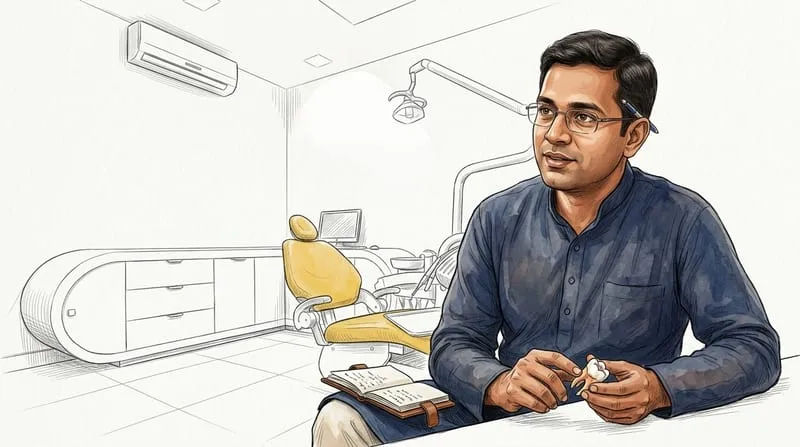
The clinical case and outcome are from Dr. Saurabh Shrivastava's practice.
Sunil came in with a small spiral notebook. He was 38, a secondary school science teacher in Kolar Road, and he had written down 7 questions before his appointment. He explained, slightly apologetically, that he had been to 3 different dental clinics in 4 years and had left every one without understanding what had been done to him or why.
"I do not want to be treated like I should just sit quietly and open my mouth," he said. "I want to understand what is happening in my own teeth."
That is entirely reasonable, and I told him so. The examination came first. Heavy supragingival calculus on the lower anteriors, 2 interproximal cavities — both early — on the upper right premolars, and a worn incisal edge on the lower left central incisor that suggested habitual clenching. His gum pockets were within normal limits at all sites except the two lower anterior locations with calculus — 4 mm there. No bone loss on the X-ray.
I turned the screen toward him and walked through each finding. The calculus on the intra-oral camera. The small cavities on the bitewing X-ray — dark triangles at the contact points, both early, not near the pulp. The worn incisal edge and what it suggested. He wrote notes as I spoke.
"The cavities — can I wait on those?" he asked.
"They are early. If you come back in 3 months for the scaling and bring the X-ray, I can compare and confirm they have not grown. But early cavities in contact areas tend to progress — the earliest intervention is the smallest one. Your call." He decided to treat both the same day. Good decision.
We did the dentist in bhopal check-up thoroughly — scaling first, 30 minutes, then the 2 composite fillings, another 25 minutes. Before he left, I answered all 7 questions from his notebook. The clenching question led to a discussion about a night guard — he agreed to trial a soft splint, which I delivered 10 days later. He has worn it every night since.
At his six-month recall, he arrived with 4 new questions. The fillings were intact, the gum pockets at the lower anteriors had reduced to 3 mm, and the incisal wear had slowed visibly with the night guard in place. "I referred 2 people from the school staff room," he said. "I told them: bring a notebook. Ask everything."
At his 12-month visit, no new cavities. The night guard was still functioning. He had started flossing daily — not because he was told to, but because once he understood the mechanics of interproximal decay, the habit made logical sense to him. That is what answering questions actually does: it converts compliance into understanding, and understanding lasts longer.
BDS, MDS Prosthodontist · DCI A-04860 · Smile Gallery, Bhopal
| Follow-up | 12 months (2 six-monthly visits) |
| Cavities | 2 composite fillings intact; no new interproximal decay at 12 months |
| Gum pockets | Reduced from 4 mm to 3 mm at lower anterior sites after scaling |
| Incisal wear | Slowed with nightly soft occlusal splint; no new wear at 12 months |
| Ongoing care | 6-monthly check-up + annual bitewing X-rays to monitor contact areas |
Frequently Asked Questions
What does a routine dental check-up include?
A clinical exam, scaling and polishing where indicated, oral cancer screening, gum assessment, X-rays where needed, and a written plan for any issues found.
Is comprehensive care available at Smile Gallery in Bhopal?
Yes. Smile Gallery, in Arera Colony, offers preventive, restorative, prosthodontic, orthodontic, and paediatric care.
How long does a check-up take?
30 to 45 minutes for adults.
What should I expect after a check-up?
A written plan and a six-monthly review schedule.
How do I book an appointment at Smile Gallery, Arera Colony?
Call +91 9200700750.
Ready for a consultation?
Visit Smile Gallery Dental Wellness Centre, E-4/205, Main Rd 3, near Flower Market, E-4, Arera Colony, Bhopal.
Open Monday to Saturday 10am–2pm and 5–9pm.
