
Preventive dentistry adapts to life stage — gentle paediatric care for infants, sealants and orthodontic checks in childhood, hygiene and bite maintenance in adulthood, and gum care, sensitivity, and prosthetic support in older age. Six-monthly check-ups remain the constant.
Medically reviewed by Dr. Kirti Shrivastava, BDS MDS, PhD Prosthodontist (DCI: A-01281). Last updated: May 2026.
Preventive dentistry adapts to each life stage — gentle paediatric care for infants and toddlers, sealants and orthodontic screening in childhood, hygiene and bite maintenance through adulthood, and increased attention to gum care, sensitivity, and prosthetic support in older age — but the foundation, a six-monthly check-up, remains constant throughout life. Dr. Saurabh Shrivastava, BDS MDS Prosthodontist (DCI: A-04860) at Smile Gallery Dental Wellness Centre, Arera Colony, designs preventive plans for patients from Hoshangabad Road and surrounding areas across every life stage. Catching issues early avoids the bigger interventions that follow neglect; even root canal therapy, with its 95% success rate over 10 years, is preferable to repeat professional teeth cleaning for cavities that could have been prevented.
Infancy and Early Childhood (0 to 6 Years)
Dental care begins with the first tooth. Wipe gums with a clean cloth before teeth appear; once the first tooth is in, brush gently with a smear of fluoride toothpaste. Avoid bottles of milk or juice in bed, the most common cause of early childhood caries. The first dental visit should happen by the first birthday — short, friendly, and largely about getting the child used to the chair.
School-Age Children (6 to 12 Years)
Permanent molars erupt around age six and again at twelve. Both are excellent candidates for sealants — a thin protective coating placed in the deep grooves where food gets trapped. Six-monthly check-ups allow fluoride application, early orthodontic screening, and detection of grinding habits or thumb-sucking that may need attention. Brushing technique is reinforced because children at this age usually take over from parents but still need supervision.
According to Dr. Kirti Shrivastava, MDS, PhD Prosthodontist: "Fissure sealants applied to the first permanent molars at age six are one of the most cost-effective preventive interventions in dentistry — those molars are the hardest-working teeth in the mouth and the first to develop cavities, yet a thin coating placed in one visit protects the deep grooves for up to ten years."
Teenagers and Young Adults (13 to 25 Years)
This stage adds orthodontic considerations, wisdom tooth monitoring, sports mouthguards, and the early effects of lifestyle — sweetened drinks, study-fuelled snacking, and irregular routines. Whitening enquiries are common; the answer is often to first ensure no active decay or gum issues, and then proceed safely. Tobacco and excessive alcohol awareness is part of the conversation as patients move into adulthood.
"A child's first dental visit by the first birthday is not about treating disease — it is about removing the fear before it forms. The parent who normalises the dental chair at age one is giving their child a gift that protects them for the next eighty years. I have seen what happens when that window is missed, and it is entirely preventable."
Dr. Kirti Shrivastava · BDS, MDS, PhD Prosthodontist, IPS-OL2283
Adults (26 to 60 Years)
The adult focus is on maintaining what is there. Gum care becomes more important — bleeding gums are not normal and should be addressed early. Worn fillings or chipped teeth are repaired before they progress. Patients who clench or grind are offered night guards. Aesthetic concerns can be planned thoughtfully alongside health priorities, and missing teeth are replaced with bridges or implants before bone loss accelerates.
- Age 0–6: Start before the first tooth — wipe gums with a clean damp cloth from birth and introduce a soft brush with a smear of fluoride toothpaste when the first tooth appears. Avoid milk bottles in bed; the lactose pools around the teeth and causes rapid early childhood caries.
- Age 6–12: Sealants on the new molars — permanent first molars erupt around age six, and the deep grooves in their chewing surfaces trap food that brushing cannot dislodge. A sealant applied at the first visit after eruption prevents the most common type of childhood cavity.
- Age 13–25: Address lifestyle risks early — sweetened energy drinks, irregular sleep and eating schedules, and the start of tobacco or alcohol use all accelerate dental disease in this decade. Orthodontic monitoring and wisdom tooth assessment belong at this stage.
- Age 26–60: Protect what is there — grinding and clenching become more common in the thirties and forties and silently wear enamel. A night guard prescribed before the damage is severe preserves years of tooth structure. Gum care, not just cavity care, becomes the priority.
- Age 60+: Manage dry mouth and root surfaces — medication-induced dry mouth dramatically raises cavity risk in older adults. Fluoride varnish at every visit, more frequent check-ups, and daily interdental cleaning protect the exposed root surfaces that become more vulnerable as gums naturally recede with age.
Older Adults (60+ Years)
Older adults benefit from full-mouth assessments to maintain function. Dry mouth — often a side effect of medications — increases cavity risk and needs attention. Dentures and implant prostheses need regular review and tissue checks. Gum recession and root surface decay become more common, both of which respond to fluoride and gentle brushing technique. Oral cancer screening is part of every visit.
According to Dr. Kirti Shrivastava, MDS, PhD Prosthodontist: "Patients over sixty who take multiple medications are at significantly higher cavity risk because many common drugs reduce saliva flow, and saliva is the mouth's natural defence against both acid and bacterial overgrowth — a medicated older adult needs closer monitoring, not less, and often benefits from fluoride varnish at every visit."
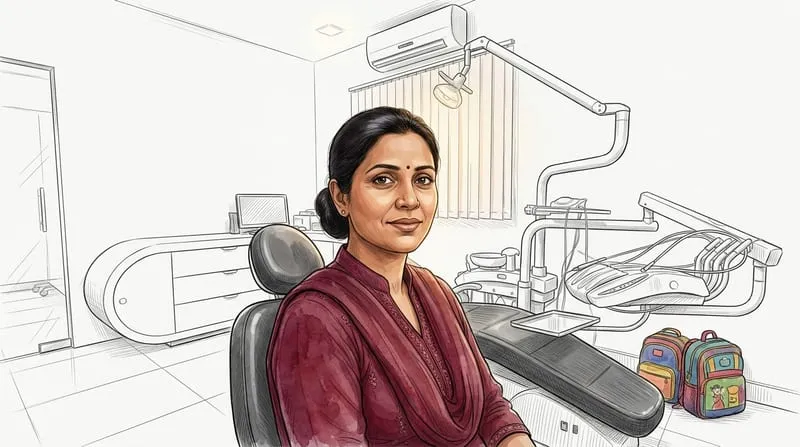
The clinical case and outcome are from Dr. Kirti Shrivastava's practice.
Meena came in on a Tuesday afternoon in October with both her children — a 7-year-old son and a 4-year-old daughter. She was 38, worked as a bank employee in TT Nagar, and had heard about family preventive check-ups from a colleague.
"My son's school dentist said he needs sealants on his back teeth," she told me. "I did not know what that meant. My daughter has some dark spots I have been worried about. And I myself have not seen a dentist in five years."
I examined all three of them that afternoon. The son's first permanent molars had erupted at age 6 and the deep grooves were already showing early plaque retention — no cavities yet, but the vulnerability was clear. His younger sister had 2 cavities in her primary upper molars, still small enough for glass ionomer restorations. Meena herself had moderate calculus, 1 early interdental cavity on a lower premolar, and gums that bled on probing at 5 sites.
I explained to Meena that what she was seeing across all three of them was one connected picture. "Your son is at the perfect moment for sealants — the window is the first two years after a molar erupts. After that the grooves accumulate enough calculus to make the sealant bond unpredictable. Your daughter's cavities are very small; we treat them today and they will not return if the diet changes slightly. And your gum bleeding will resolve with a single scaling and better home care."
We treated the daughter's cavities that afternoon — glass ionomer in both upper primary molars, 15 minutes each. I placed sealants on the son's 4 permanent molars the following week. Meena had her full-mouth scaling at the same second appointment.
Three weeks later, Meena sent a message through the clinic's number. Her son had asked her why he needed to go to the dentist if his teeth did not hurt. She had explained it to him using what I had told her. "He actually understood," she wrote. "He is now the one reminding his sister to brush at night."
At their 6-month review, Meena's gum bleeding had completely resolved. The daughter's fillings were intact. The son's sealants were in perfect condition, and the grooves they covered showed no sign of staining. I enrolled all three of them in preventive dentistry recall at six-monthly intervals. Meena added her mother-in-law, who was 64 and on blood pressure medication, to the schedule for the following month — correctly identifying that dry mouth from the medication was a risk she wanted addressed.
BDS, MDS, PhD Prosthodontist · DCI A-01281 · Smile Gallery, Bhopal
| Follow-up | 6 months (whole family) |
| Fissure sealants (son, age 7) | All 4 permanent molars sealed, no staining at 6 months |
| Primary molar cavities (daughter, age 4) | 2 glass ionomer fillings intact, no new decay |
| Gum bleeding (mother, age 38) | Resolved completely after scaling and improved home care |
| Ongoing care | 6-monthly family recall; mother-in-law enrolled for medication-related dry-mouth monitoring |
Frequently Asked Questions
What does a preventive check-up include at any age?
A clinical exam, scaling and polishing where indicated, fluoride application or sealants where age-appropriate, oral cancer screening, and a written plan for any issues found.
Are preventive services available at Smile Gallery in Bhopal?
Yes. Smile Gallery, in Arera Colony, offers preventive care for every age group, with appointments easily booked from Hoshangabad Road and across the city.
How long does a preventive visit take?
30 to 45 minutes for adults; 20 to 30 minutes for children.
What should I expect after a preventive visit?
Most patients leave with cleaner teeth and a written plan. Mild gum tenderness for a day after a deep cleaning is normal.How do I book a check-up at Smile Gallery, Arera Colony?
Call +91 9200700750. Whole-family slots can be arranged together.
Ready for a consultation?
Visit Smile Gallery Dental Wellness Centre, E-4/205, Main Rd 3, near Flower Market, E-4, Arera Colony, Bhopal.
Open Monday to Saturday 10am–2pm and 5–9pm.
