

The five common oral health mistakes are: skipping the first dental visit until pain starts, brushing too hard or too gently, skipping floss, frequent sugary and sticky snacks, and ignoring dental anxiety. Fix each with the right technique, schedule, and dental support.
Medically reviewed by Dr. Saurabh Shrivastava, BDS MDS Prosthodontist, Certified Digital Smile Designer (DSD) (DCI: A-04860). Last updated: May 2026.
The five most common oral health mistakes — skipping the first dental visit until pain starts, brushing too hard or too gently, skipping floss, frequent sugary and sticky snacks, and ignoring dental anxiety — each have simple fixes when caught early, an approach Dr. Saurabh Shrivastava, BDS MDS Prosthodontist (DCI: A-04860) at Smile Gallery Dental Wellness Centre, Arera Colony, brings to patients from Awadhpuri and across Bhopal. Catching habits early avoids the more involved root canal treatment in Bhopal that follows neglected oral care.
1. Skipping the First Dental Visit Until Pain Starts
The fix: schedule a routine check-up every six months — for adults and children — regardless of whether anything hurts. Most cavities and early gum problems do not cause pain in the early stages. Six-monthly visits catch them while they are still simple to treat. For children, the first dental visit should happen by age one or within six months of the first tooth.
2. Brushing Too Hard (Or Too Soft)
The fix: switch to a soft-bristled brush and use gentle circular strokes at the gum line for two minutes. Hard horizontal scrubbing wears enamel and causes gum recession; very soft brushing leaves plaque behind. The goal is gentle thoroughness, not pressure. Electric brushes with built-in pressure sensors help patients who tend to scrub.
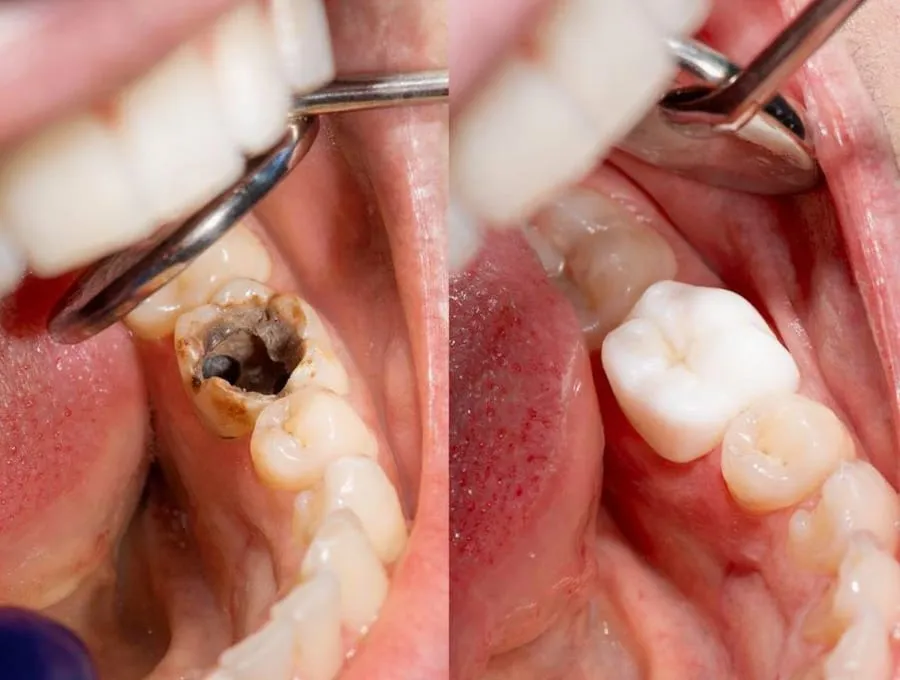
According to Dr. Saurabh Shrivastava, MDS Prosthodontist: "The single most common mistake I see in Bhopal patients is waiting for pain before visiting a dentist — but cavities and early gum disease are silent for months, sometimes years, and by the time they hurt the repair is already three times more involved than it would have been at a routine check-up."
3. Skipping Floss
The fix: floss once a day, ideally before brushing in the evening. Brushing alone misses the surfaces between teeth, where most adult cavities form. If conventional floss is awkward, interdental brushes (in graded sizes) or a water flosser are easier alternatives — what matters is that the gaps between teeth are cleaned daily.
"Preventing a cavity takes two minutes a day. Treating a cavity that has spread to the pulp takes two visits and ten times the cost. The habits that protect your teeth are not complicated — they are just easy to skip until the damage is already done."
Dr. Saurabh Shrivastava · BDS, MDS Prosthodontist, DCI A-04860
4. Frequent Sugary and Sticky Snacks
The fix: limit sweets to mealtimes and finish them in one sitting rather than spreading sips and bites through the day. The mouth recovers between exposures; constant grazing keeps the acid attack going. Sticky candies, packaged fruit juices, and sweetened tea or coffee are the biggest contributors. Water between meals is the simplest swap.
According to Dr. Saurabh Shrivastava, MDS Prosthodontist: "Brushing hard does not mean brushing well — I routinely see patients with severe gum recession on the upper canines because they scrub horizontally with a medium-bristled brush. Switching to a soft brush with gentle circular strokes at the gum line costs nothing and reverses years of slow enamel and root surface wear."
5. Ignoring Dental Anxiety
The fix: tell the receptionist you are anxious when booking; the team will plan a longer slot. A first appointment with no treatment, just a relaxed consultation, builds confidence. Hand signals (raise your hand to pause) give back control. For severe anxiety, sedation options may be appropriate — discuss with the dentist.
- Waiting for pain before visiting the dentist — cavities and gum disease are silent in early stages. A six-monthly check-up catches problems while they are still one-visit fixes rather than multi-visit restorations.
- Brushing too hard or with the wrong technique — horizontal scrubbing with a medium-bristled brush wears enamel and pushes gums down. Switch to a soft brush, gentle circular strokes, two minutes, twice daily.
- Skipping floss or interdental cleaning — brushing reaches only three of five tooth surfaces. The two surfaces between teeth are where most adult cavities form. Floss, interdental brushes, or a water flosser fills the gap.
- Grazing on sugary and sticky snacks through the day — each sugary exposure triggers an acid attack that lasts 20 to 30 minutes. Finishing a sweet snack in one sitting and rinsing with water gives the mouth time to recover between attacks.
- Ignoring dental anxiety instead of naming it — anxiety kept silent leads to avoidance, which leads to bigger problems. Telling the receptionist at booking allows the team to plan a gentler, longer slot and restore confidence gradually.
How These Fixes Compound Over Years
In short: avoiding these common oral health mistakes — and building the opposite habits, like those in our oral health tips guide — prevents most cavities, gum disease, and extractions over a lifetime.
None of these fixes is dramatic on its own. Together, sustained over years, they prevent the majority of cavities, gum disease, and extractions. Patients who establish these habits in their thirties often need very little restorative work in their fifties and sixties. Patients who establish them in childhood often go their whole lives with very little dental treatment beyond routine cleaning.
A Simple Daily Routine
Morning: brush for two minutes with a soft brush and fluoride toothpaste; rinse only lightly so the fluoride stays on the teeth a while longer. Through the day: drink water, finish any sweet snack in one sitting, rinse with water afterwards. Evening: floss or use interdental brushes; brush again. That single routine, done consistently, does most of the heavy lifting.
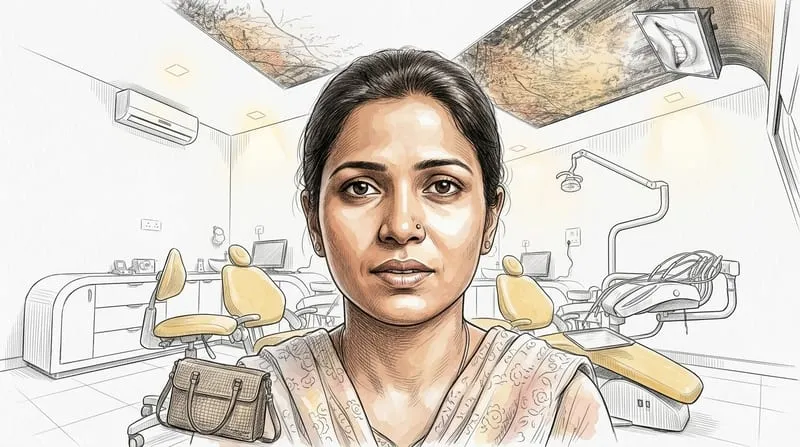
The clinical case and outcome are from Dr. Saurabh Shrivastava's practice.
Priya came in on a Saturday morning in February, referred by a colleague who taught at the same school in Govindpura. She was 34, had been teaching primary school for 8 years, and had not visited a dentist since a painful filling at age 22 had left her convinced that dentistry was best avoided unless absolutely necessary.
"My gums bleed when I brush," she said quietly. "And I have a toothache on the lower left that comes and goes. I kept hoping it would settle on its own."
The examination showed the cost of that 12-year avoidance. Heavy supragingival calculus on the lower anteriors, generalised marginal gingivitis bleeding at 10 of 12 probing sites, 4 cavities — the lower-left molar the most advanced, with decay that had reached the pulp. The upper premolars had 2 smaller interproximal cavities that were still confined to dentine. Her oral health had silently deteriorated through years of delayed care.
When I asked about her routine, she described horizontal scrubbing with a medium-bristled brush once a day, no flossing, and a habit of sipping sweetened tea through her teaching hours — roughly 5 to 6 cups spread across the day. She had never been told these were the exact habits driving her problems.
I explained each finding plainly. "The lower molar needs root canal treatment — the decay has reached the nerve. But the other 3 cavities are still small and can be filled simply. The gum bleeding is the calculus — once we scale it off and you change the brushing technique, it will stop within 2 weeks. None of this is an emergency, but none of it will get better without treatment."
We started with the full-mouth scaling — 45 minutes. I showed her the modified Bass technique on a model: soft brush, 45-degree angle, small circular strokes at the gum line. We filled the 2 upper premolar cavities with composite that same day. The root canal on the lower molar was completed across 2 subsequent visits. A ceramic crown was placed 3 weeks later.
At her review 4 weeks later, the gum bleeding had stopped at all but 1 site, the treated molar was asymptomatic, and she had reduced her tea to 2 cups and started using interdental picks in the evenings. "I had no idea the tea throughout the day was part of the problem," she said. "And the brushing — I was actually damaging my own gums."
At her 6-month check-up, all probing sites were within normal limits, no new cavities, and the composite fillings and crown were intact. She booked her next check-up before leaving — the first time in her adult life she had done so before something hurt.
BDS, MDS Prosthodontist · DCI A-04860 · Smile Gallery, Bhopal
| Follow-up | 6 months post-treatment |
| Gum bleeding | Resolved completely by week 3 post-scaling |
| Root canal molar | Asymptomatic, ceramic crown intact at 6 months |
| Composite fillings | 3 fillings intact, no secondary decay |
| Ongoing care | 6-monthly check-up and scaling booked proactively |
Frequently Asked Questions
What is the most common oral health mistake?
Skipping six-monthly check-ups until pain starts. Most cavities and early gum disease are silent in the early stages.
Are these services available at Smile Gallery in Bhopal?
Yes. Smile Gallery, in Arera Colony, offers six-monthly preventive check-ups, professional cleaning, and full restorative care under Dr. Saurabh Shrivastava (DCI: A-04860).
How long does a routine check-up and cleaning take?
30 to 45 minutes for adults.
What should I expect after a check-up?
A written plan listing any priority work, optional procedures, and a follow-up timeline.
How do I book an appointment at Smile Gallery, Arera Colony?
Call +91 9200700750.
Ready for a consultation?
Visit Smile Gallery Dental Wellness Centre, E-4/205, Main Rd 3, near Flower Market, E-4, Arera Colony, Bhopal.
Open Monday to Saturday 10am–2pm and 5–9pm.