


Dental health depends on daily plaque control, balanced nutrition, regular check-ups, and timely treatment of cavities and gum problems. At Smile Gallery in Arera Colony, Dr. Saurabh Shrivastava (DCI: A-04860) helps patients prevent and manage common dental issues.
Medically reviewed by Dr. Saurabh Shrivastava, BDS MDS Prosthodontist, Certified Digital Smile Designer (DSD) (DCI: A-04860). Last updated: May 2026.
Good dental health rests on four pillars — daily plaque control, balanced nutrition, six-monthly professional check-ups, and timely treatment of any decay or gum problems — and these are the principles Dr. Saurabh Shrivastava, BDS MDS Prosthodontist (DCI: A-04860), Certified Digital Smile Designer, applies for every patient at Smile Gallery Dental Wellness Centre, Arera Colony. From simple cleaning to advanced gum treatment, the clinic addresses the full range of common concerns; even root canal treatment, when needed, has a 95% success rate over 10 years with modern technique.
Why Dental Health Matters Beyond the Mouth
The health of your mouth and the rest of your body are connected. Chronic gum disease has been linked to higher risks of heart disease, poor diabetic control, and adverse pregnancy outcomes. Untreated cavities affect chewing, which in turn affects nutrition and digestion. Persistent dental pain disrupts sleep and concentration. Looking after your teeth and gums is a practical part of overall health, not a cosmetic add-on.
Common Dental Problems and How to Spot Them
The most common problems are dental caries (cavities), gingivitis (early gum inflammation), periodontitis (advanced gum disease), tooth sensitivity, and tooth loss from decay or trauma. Early signs include bleeding while brushing, bad breath that does not respond to mouthwash, sharp pain when eating cold or sweet foods, and visible darkening or holes on tooth surfaces. Each of these is easier to treat the earlier it is caught.
According to Dr. Saurabh Shrivastava, MDS Prosthodontist: "The single most damaging habit I see in Bhopal patients is grazing — eating biscuits, namkeen, and sweet tea across the entire day rather than in one sitting. Every time sugar enters the mouth, the pH drops for twenty minutes. Twelve grazing episodes means four hours of acid attack daily — far more damaging than one dessert after lunch."
Preventive Habits That Actually Work
Brush twice daily with a fluoride toothpaste using gentle circular strokes. Floss or use interdental brushes once a day. Limit sugary snacks and drinks; if you have them, finish them in one sitting rather than sipping or grazing. Drink plenty of water. Replace your toothbrush every three months. These five habits — sustained over time — prevent the majority of dental problems.
"Pain is a late warning in dentistry. By the time a tooth hurts, the problem has usually moved beyond a filling into root canal territory. The six-monthly check-up exists precisely to catch the five-minute filling before it becomes the two-visit root canal — and that is a trade almost everyone would make if they understood it."
Dr. Saurabh Shrivastava · BDS, MDS Prosthodontist, DCI A-04860
When to See a Dentist — Don’t Wait for Pain
Routine check-ups every six months catch problems while they are still small and inexpensive to fix. Book an earlier appointment if you notice bleeding gums, persistent bad breath, sensitivity that lingers, a chipped or cracked tooth, or any visible discoloration. Pain is a late warning — by the time a tooth hurts, the underlying problem has often progressed beyond a simple filling.
- Brush with fluoride paste, not harder — fluoride remineralises early enamel lesions before they become cavities. A gentle two-minute session with a soft-bristled brush and any fluoride toothpaste outperforms vigorous scrubbing with a medium brush that abrades the gum line over years.
- Clean between teeth every day — brushing misses the contact points between teeth where most cavities actually start. Floss, interdental brushes, or a water flosser — whichever you will actually use daily — prevents the majority of interproximal decay.
- Finish sugar in one sitting — every sugar exposure triggers a twenty-minute acid attack. One dessert after a meal is one attack. Sipping a sweet drink over two hours is twenty attacks. Consolidating sweet intake is the simplest dietary change with the largest dental benefit.
- Replace your toothbrush every three months — frayed bristles lose up to forty percent of their cleaning efficiency. The cost of a new brush every quarter is a fraction of a single filling.
- Attend a check-up every six months — before it hurts — cavities and early gum disease have no symptoms. A six-monthly visit catches problems at the stage where a small filling or a scaling session resolves them completely. Waiting for pain almost always means a larger, costlier treatment.
Treatments Available at Smile Gallery
The clinic offers preventive cleaning and fluoride application, tooth-coloured fillings, single-sitting and multi-visit root canal treatment, dental crowns and bridges, dental implants, smile design, teeth whitening, dental veneers, gum treatment, paediatric dentistry, and orthodontic care including braces and clear aligners. Treatment plans are presented in writing with priority and optional steps clearly marked, so patients can make informed decisions at their own pace.
Special Considerations for Different Life Stages
Children benefit from sealants, fluoride application, and habit counselling under Dr. Kirti Shrivastava (DCI: A-01281). Teenagers may need orthodontic evaluation as adult teeth settle in. Adults often face wear, gum recession, and the early need for crowns or implants. Older patients benefit from full-mouth assessments to maintain function. The clinic in Arera Colony serves all age groups under one roof.
According to Dr. Saurabh Shrivastava, MDS Prosthodontist: "Gum disease and heart disease share the same inflammatory pathway — bacteria from the mouth enter the bloodstream through bleeding gums and trigger low-grade systemic inflammation. Controlling gum disease in a diabetic patient consistently improves their HbA1c by around half a percent. The mouth is not separate from the rest of the body."
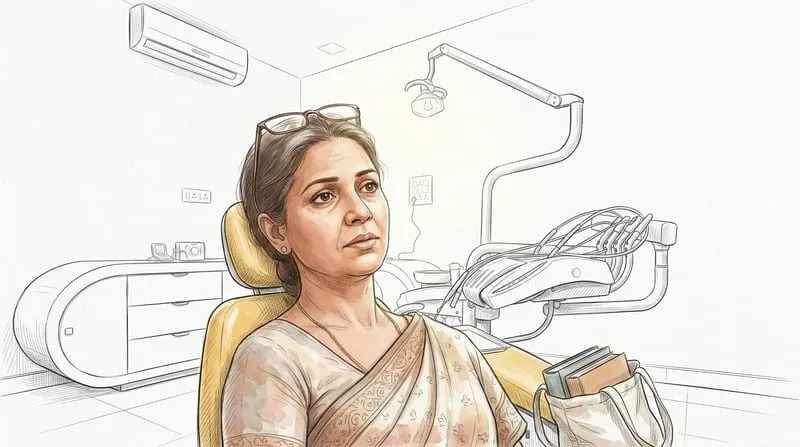
The clinical case and outcome are from Dr. Saurabh Shrivastava's practice.
Savitri came in on a Monday afternoon in March, a schoolteacher from Govindpura, 52 years old, referred by her physician after a routine blood test flagged improved blood sugar. Her doctor had asked her to have her gums checked as part of the diabetic workup — a connection she had never heard of before.
"I brush every morning," she said, slightly defensive. "I have never had a toothache. Why would my gums be a problem?"
The examination told a different story. Generalised moderate periodontitis — gum pockets of 4 to 6 mm across the posterior teeth, bleeding on probing in 11 of 14 sites, and a bone level on OPG that had dropped by approximately 2 mm around the lower molars. She had 4 cavities — all interproximal, all in the early-to-moderate range, none causing pain yet. Her dental health had been declining silently for years.
I explained the link her physician had flagged. "Bacteria in the gum pockets release inflammatory signals that make the body resist insulin more. Treating the gum disease does not cure diabetes, but it helps control it — studies consistently show a reduction in HbA1c of around 0.5 percent after periodontal treatment. Your physician is right to have sent you here."
The treatment plan was structured across 3 visits. The first two were full-mouth scaling and root planing under local anaesthesia — 90 minutes total across both quadrants. The third visit, two weeks later, addressed all 4 cavities with tooth-coloured composite restorations in a single 75-minute session. I also reviewed her brushing technique — she was using a horizontal scrub with a medium-bristled brush and had visible cervical abrasion notches on 3 teeth.
"Switch to a soft brush. Use small circular strokes at the gum line, not a side-to-side motion. Add an interdental brush — I will show you which size fits your gaps — and use it every night before bed. That is the change that prevents this from coming back."
At her review 6 weeks later, probing depths had reduced to 3 to 4 mm across most sites. Bleeding on probing was down to 3 of 14 sites. Her physician reported that the HbA1c at the 3-month blood test had dropped from 7.9 to 7.3.
I scheduled her for four-monthly check-ups given the diabetic status and history of bone loss. At the 12-month review, all 4 fillings were intact, no new cavities, and the bone level on OPG was stable. She had brought her husband along for his first check-up in 8 years.
BDS, MDS Prosthodontist · DCI A-04860 · Smile Gallery, Bhopal
| Follow-up | 12 months (4-monthly reviews for diabetic patient) |
| Periodontal pockets | Reduced from 4–6 mm to 3–4 mm across posterior teeth |
| Gum bleeding | Resolved at 11 of 14 sites by week 6 |
| HbA1c correlation | Dropped from 7.9 to 7.3 at 3-month systemic review |
| Ongoing care | 4-monthly scaling and check-up given diabetic history |
Frequently Asked Questions
What does a complete dental health check-up include?
An oral cancer screening, gum assessment, cavity detection with X-rays where needed, bite evaluation, and a written treatment plan if anything needs attention.
Are these services available at Smile Gallery in Bhopal?
Yes. Smile Gallery Dental Wellness Centre, located at E-4/205, Main Rd 3, near Flower Market, E-4, Arera Colony, Bhopal, offers comprehensive preventive, restorative, and cosmetic care.
How long does a routine check-up take?
Approximately 30 to 45 minutes including exam, scaling and polishing, and a discussion of any findings.
What should I expect after a cleaning or filling?
Mild gum tenderness for a day after a deep cleaning is normal. Fillings settle within 24 hours; report any persistent biting discomfort so the bite can be adjusted.
How do I book an appointment at Smile Gallery, Arera Colony?
Call +91 9200700750 to schedule a check-up or specific consultation. Whole-family appointments can be arranged together.
Ready for a consultation?
Visit Smile Gallery Dental Wellness Centre, E-4/205, Main Rd 3, near Flower Market, E-4, Arera Colony, Bhopal.
Open Monday to Saturday 10am–2pm and 5–9pm.
