

The investment in professional teeth cleaning cost in Bhopal depends on the type of cleaning needed (routine versus deep cleaning), the amount of tartar present, and any additional steps like fluoride application. Routine cleaning is recommended every 6 months. Book a consultation at Smile Gallery for a personalised plan.
Medically reviewed by Dr. Saurabh Shrivastava, BDS MDS Prosthodontist, Certified Digital Smile Designer (DSD) (DCI: A-04860). Last updated: May 2026.
- Wait — Isn’t Brushing Enough?
- What Is Professional Teeth Cleaning?
- Routine Cleaning vs Deep Cleaning
- What Influences Teeth Cleaning Cost in Bhopal?
- How Often Should You Get a Cleaning?
- Is the Procedure Painful?
- What Happens If You Skip Teeth Cleaning?
- What to Do After Your Cleaning
- Frequently Asked Questions
Teeth cleaning cost in Bhopal depends on a few practical factors — whether you need a routine cleaning or deep cleaning (scaling and root planing), how much hardened tartar has built up, whether fluoride application is added, and the experience of the dentist performing it — and a precise figure for your case comes from a quick assessment at the first visit. At Smile Gallery Dental Wellness Centre, Arera Colony, Dr. Saurabh Shrivastava, BDS MDS Prosthodontist (DCI: A-04860), provides a written estimate after a brief gum assessment for patients from MP Nagar and across Bhopal. Routine professional teeth cleaning is recommended every 6 months for healthy mouths.
How much does teeth cleaning cost?
Teeth cleaning cost depends on three things: how much tartar has built up, whether your gums need deep cleaning below the gumline, and how many sittings it takes. Simple scaling and polishing costs less than deep cleaning for gum disease. At Smile Gallery, Arera Colony, Bhopal, we examine your gums first and tell you the exact cost before we start.
Teeth Cleaning Cost in Bhopal — Why It’s Worth It
Brushing and flossing reach most plaque, but tartar that hardens at the gum line cannot be removed at home. Tartar is mineralised plaque; it requires professional instruments to lift safely. Without periodic professional cleaning, tartar accumulates, gums inflame, and small problems progress to larger ones.
What Is Professional Teeth Cleaning?
In short: professional teeth cleaning is an examination, scaling to remove plaque and tartar, polishing, and fluoride where indicated — usually 30 to 45 minutes for a routine visit.
Professional cleaning has four parts. First, an examination checks for cavities, gum health, and any other concerns. Second, scaling removes plaque and tartar with ultrasonic and hand instruments. Third, polishing smooths tooth surfaces and removes residual stain. Fourth, fluoride application strengthens enamel where indicated. The whole process takes 30 to 45 minutes for a routine cleaning.
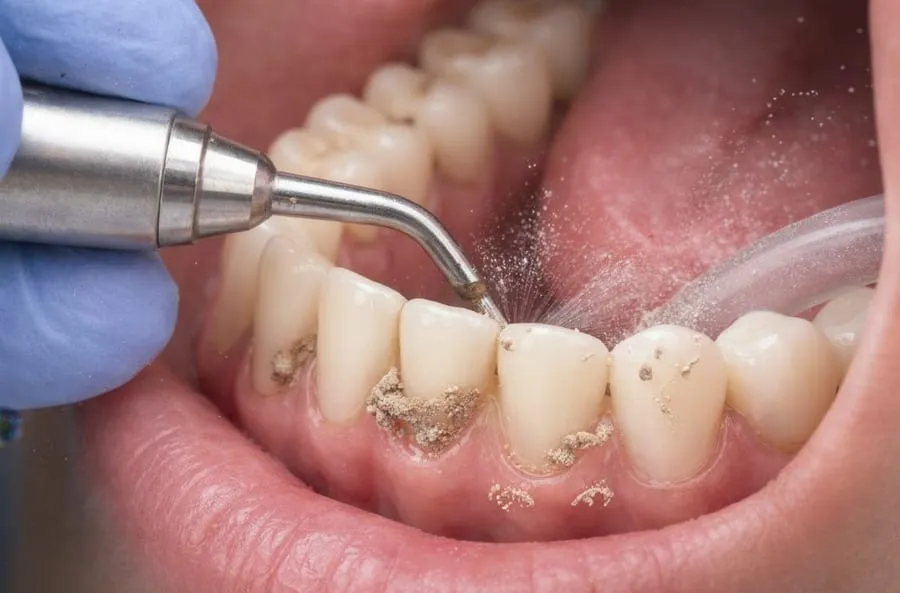
According to Dr. Saurabh Shrivastava, MDS Prosthodontist: "Tartar hardens from plaque within 48 hours and cannot be removed by any toothbrush or home device — once it mineralises at the gum line, only an ultrasonic or hand scaler can lift it safely. Patients who attend every six months need a much shorter and simpler cleaning than those who arrive after two or three years, and the difference in chair time and complexity is reflected directly in the cost."
Routine Cleaning vs Deep Cleaning
Routine cleaning treats a healthy or mildly inflamed mouth. Deep cleaning (scaling and root planing) is needed when gum measurements show pockets deeper than 4 mm, when there is bleeding on probing, or when X-rays show early bone loss. Deep cleaning is performed under local anaesthesia and is usually completed in one to two longer visits. The two are different treatments for different situations.
"Skipping professional cleaning is not saving money — it is deferring a small predictable cost into a larger unpredictable one. The scaling that takes 30 minutes now prevents the deep cleaning, fillings, and eventual extractions that accumulate when tartar is left in place for years."
Dr. Saurabh Shrivastava · BDS, MDS Prosthodontist, DCI A-04860
What Influences Teeth Cleaning Cost in Bhopal?
Quick answer: teeth cleaning cost in Bhopal depends on whether you need routine or deep cleaning, how much tartar has built up, any add-ons like fluoride or sealants, and the clinician’s experience and technology.
The type of cleaning matters most: a routine cleaning is far less involved than a deep cleaning. The amount of tartar present matters too — patients who attend every six months need shorter, simpler cleanings than those who have not visited for years. Add-ons like fluoride application, sealants for permanent molars, or any small investigative work add to the visit. The experience of the dentist and the technology used (ultrasonic scaling, air polishing) all factor in.
According to Dr. Saurabh Shrivastava, MDS Prosthodontist: "Deep cleaning — scaling and root planing — is a different procedure from routine scaling, performed under local anaesthesia when gum pockets exceed 4 mm or when early bone loss is visible on an X-ray. Patients often arrive expecting a simple cleaning and discover they need deep cleaning; this is not an upsell, it is a clinical distinction, and skipping it means the bone loss continues silently."
How Often Should You Get a Cleaning?
Six-monthly is the general recommendation for healthy adults. Patients with diabetes, smokers, or those with a history of gum disease may benefit from a three or four-monthly schedule for the first year after deep cleaning, returning to six-monthly once stable. Children should also be on a six-monthly schedule from age one onwards.
- Routine versus deep cleaning — Routine scaling treats a healthy or mildly inflamed mouth in 30 to 45 minutes. Deep cleaning (scaling and root planing) is needed when pockets exceed 4 mm or bone loss is present — it requires local anaesthesia and is typically split across one or two longer visits.
- Volume of tartar buildup — Patients who attend every six months accumulate far less calculus than those who have not visited in two or more years. The time taken — and cost — scales with the amount of mineralised deposit that needs to be removed.
- Add-on procedures — Fluoride varnish application, fissure sealants for permanent molars, air polishing for stain removal, or a digital X-ray taken during the visit each add to the total.
- Clinician experience and technology — Ultrasonic scalers, piezo units, and air polishers deliver faster and more comfortable cleaning than hand instruments alone. Specialist-led care at a dedicated prosthodontic centre reflects the level of clinical oversight involved.
- Follow-up frequency required — Patients with diabetes, a smoking history, or confirmed periodontitis may be placed on a 3 or 4-monthly recall schedule rather than 6-monthly, which affects the annual cost of maintenance.
Is the Procedure Painful?
Routine cleaning is comfortable. Mild gum tenderness for a day after a thorough cleaning is normal, especially if there has been long-standing tartar. Deep cleaning is performed under local anaesthesia and is far easier than patients fear; mild cold sensitivity for a few days afterwards settles quickly.
What Happens If You Skip Teeth Cleaning?
Plaque hardens to tartar within days. Tartar harbours bacteria that inflame gums and cause bleeding. Untreated, this becomes periodontitis, with gum pockets, bone loss, and eventual tooth loss. Cavities also progress unchecked. Skipping is not saving — it just shifts the cost into bigger interventions later.
What to Do After Your Cleaning
Eat soft foods for the first hour to let any topical fluoride sit. Brush gently for the next 24 hours; the gums will be slightly tender. Use a non-alcoholic mouthwash if recommended. Resume normal flossing the next day. Most patients notice that their gums stop bleeding when brushing within two weeks of consistent home care.
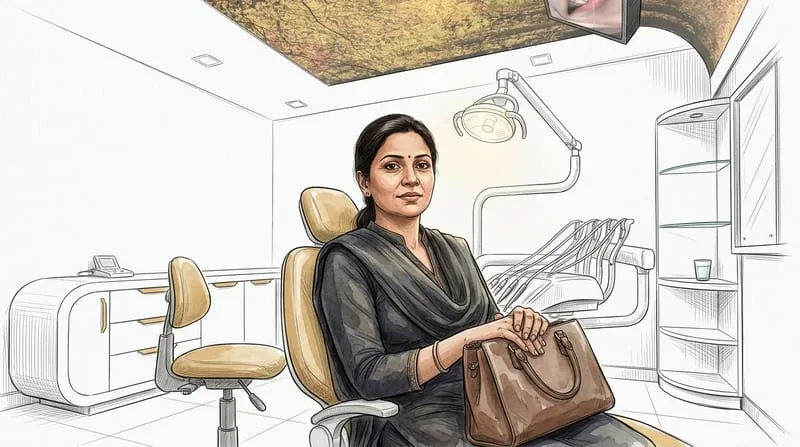
The clinical case and outcome are from Dr. Saurabh Shrivastava's practice.
Priya had been putting off her cleaning for 3 years. She was 34, a bank manager at a branch near MP Nagar, and had convinced herself that brushing twice a day made professional cleaning unnecessary. She came in finally because her gums had started bleeding every morning.
"I wanted to know the cost before I agreed to anything," she said, quite directly, setting her bag on her lap. "People say it can be expensive. I just want to understand what I am paying for."
That is exactly the right question, and I told her so. The examination came first. Her gums bled on probing at 7 of 12 sites. There was moderate supragingival calculus on the lower anteriors and light calculus around the upper molars — 3 years of accumulation was visible but not severe. Pocket depths were between 3 and 4 mm — on the boundary. No bone loss was visible on the X-ray. This was a routine teeth cleaning, not deep cleaning.
I showed her the intra-oral camera images of the calculus deposits. "This is what brushing cannot reach. The bleeding is your gums reacting to bacteria living in this tartar. Once we remove it, and you maintain home care, the bleeding stops within about 2 weeks. This is a routine scaling — about 40 minutes, no injections needed."
"And if I had waited longer?" she asked.
"If the pockets had deepened to 5 or 6 mm, we would have needed deep cleaning under local anaesthesia — significantly more involved. You came in at the right time. A 6-monthly routine from now keeps it at this level."
The scaling took 38 minutes. I added a fluoride varnish application to the lower anteriors where the enamel had been in prolonged contact with calculus. She tolerated the whole visit easily — mild discomfort at 2 sites on the lower jaw, nothing requiring anaesthesia. She left with a written aftercare sheet and a soft-bristled brush replacement.
At her 2-week follow-up call, she reported the bleeding had stopped after day 9. She booked her next cleaning before the call ended — 6 months out. "I kept thinking it would cost a lot for very little," she said. "Now I understand it is the opposite — it costs little to prevent a lot."
At her 6-month return visit, the calculus accumulation was a fraction of what we had seen before. Probing was clean at all 12 sites. The cleaning took 20 minutes. She has not missed a six-monthly appointment since.
BDS, MDS Prosthodontist · DCI A-04860 · Smile Gallery, Bhopal
| Follow-up | 12 months (2 six-monthly visits) |
| Gum bleeding | Resolved completely by day 9 post-scaling |
| Pocket depths | All sites within normal limits at 6-month check |
| Second cleaning | 20 minutes — minimal accumulation maintained by home care |
| Ongoing care | 6-monthly routine scaling + fluoride varnish as indicated |
Frequently Asked Questions
What does professional teeth cleaning involve?
Examination, scaling to remove plaque and tartar, polishing, and fluoride application where indicated. Usually 30 to 45 minutes for a routine cleaning.
Is teeth cleaning available at Smile Gallery in Bhopal?
Yes. Smile Gallery, in Arera Colony, offers routine and deep cleaning under Dr. Saurabh Shrivastava (DCI: A-04860).
How long does the appointment take?
30 to 45 minutes for routine cleaning; 60 to 90 minutes per visit for deep cleaning, usually across one to two visits.
What should I expect after the cleaning?
Smoother teeth, brighter shade where staining has been removed, and mild gum tenderness for a day if there has been long-standing tartar.
How do I get a personalised estimate at Smile Gallery, Arera Colony?
Call +91 9200700750 to schedule a brief gum assessment. A written estimate follows the assessment.
Ready for a consultation?
Visit Smile Gallery Dental Wellness Centre, E-4/205, Main Rd 3, near Flower Market, E-4, Arera Colony, Bhopal.
Open Monday to Saturday 10am–2pm and 5–9pm.