

Six facts about teeth whitening: it works only on natural teeth, DIY hacks can damage enamel, results last 1 to 3 years, sensitivity afterwards is temporary, smoking and tea/coffee shorten the result, and whitening differs from cleaning. Professional whitening done correctly is safe.
Medically reviewed by Dr. Saurabh Shrivastava, BDS MDS Prosthodontist, Certified Digital Smile Designer (DSD) (DCI: A-04860). Last updated: May 2026.
Six important facts about teeth whitening — it works only on natural teeth, DIY hacks can damage enamel, results last 1 to 3 years, post-whitening sensitivity is temporary, smoking and tea or coffee shorten the result, and whitening is not the same procedure as cleaning — together explain how to set the right expectations and choose safely. Dr. Saurabh Shrivastava, BDS MDS Prosthodontist (DCI: A-04860) at Smile Gallery Dental Wellness Centre, Arera Colony, performs in-clinic teeth whitening for patients from MP Nagar and across Bhopal, with whitening results that last 1 to 3 years depending on lifestyle.
Fact 1 — Whitening Works Only on Natural Teeth
Existing crowns, veneers, composite fillings, and bridges do not lighten with whitening. The clinician plans any shade-matching at the consultation.
Fact 2 — DIY Hacks Can Damage Enamel
Lemon juice, baking soda, charcoal powder, and aggressively used over-the-counter strips can wear enamel, irritate gums, or cause prolonged sensitivity.
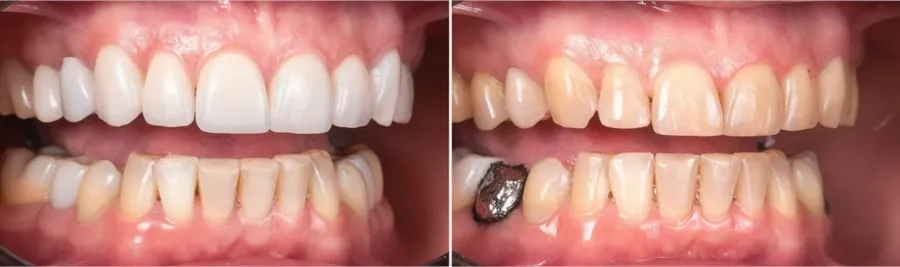
According to Dr. Aashiba, BDS: "The most common misconception I see is patients expecting whitening to work on crowns and composite fillings. Peroxide gel only lightens natural tooth enamel — it has no effect on ceramic or resin restorations. If you have visible front-tooth restorations, shade-matching those after whitening is part of the plan, and that conversation happens at the consultation, not as a surprise at the end."
Fact 3 — Results Are Not Permanent
Whitening results last 1 to 3 years. Lifestyle decides how long: heavy coffee, tea, red wine, and tobacco shorten the window.
"A scaling and polishing appointment surprises most patients — they come in wanting whitening and leave after a cleaning saying their teeth already look completely different. I always do the cleaning first. In many cases the extrinsic staining from tea, coffee, and tobacco was doing most of the discolouration, and the whitening result on a freshly cleaned tooth is both stronger and longer-lasting."
Dr. Aashiba · BDS, Smile Gallery Bhopal
Fact 4 — Sensitivity Afterwards Is Temporary
Mild cold sensitivity for one to three days after a whitening session is common; it is not damage, and it settles on its own.
- Whitening only works on natural teeth — existing crowns, veneers, composite fillings, and bridges do not respond to peroxide gel. If you have visible restorations in your smile zone, your clinician plans shade-matching before starting whitening.
- DIY hacks damage enamel rather than whiten it — lemon juice, baking soda, charcoal powder, and unapproved strips abrade or erode the enamel surface. The apparent improvement is surface loss, not shade change. Professional whitening is controlled and safe.
- Results last 1 to 3 years — lifestyle decides where in that range — heavy tea, coffee, red wine, and tobacco accelerate staining. Rinsing with water after these drinks, and using a whitening toothpaste for maintenance, push the result toward the longer end.
- Post-whitening sensitivity is temporary, not damage — mild cold sensitivity for 1 to 3 days after a session is the peroxide temporarily increasing dentinal fluid movement. It resolves on its own. A desensitising toothpaste used beforehand reduces the likelihood.
- Whitening and cleaning are different procedures — cleaning removes plaque, calculus, and surface stains. Whitening lifts the underlying intrinsic shade. Both are useful; many patients are genuinely surprised by how much a thorough cleaning alone changes the appearance.
- A clinical exam is required before whitening — active cavities, cracked teeth, or gum disease must be treated first. Starting whitening over untreated decay or gum inflammation causes unnecessary sensitivity and inconsistent results.
Fact 5 — Smoking and Tea or Coffee Shorten the Result
The most common reasons whitening fades faster than expected are tobacco use, heavy coffee or tea consumption, and red wine. Rinsing with water afterwards extends the result.
Fact 6 — Whitening and Cleaning Are Different
A professional cleaning removes plaque, tartar, and surface stains mechanically. Whitening lifts the underlying tooth shade chemically. Many patients are surprised at how much the cleaning alone improves the look.
According to Dr. Aashiba, BDS: "I often see patients who have tried lemon juice, charcoal powder, or aggressive over-the-counter strips before coming in. Some arrive with enamel erosion on the buccal surfaces that was not there six months ago. These DIY methods do not whiten effectively — they abrade. Professional whitening uses a controlled peroxide concentration for a controlled time, which is why it lightens the shade without damaging the enamel surface."
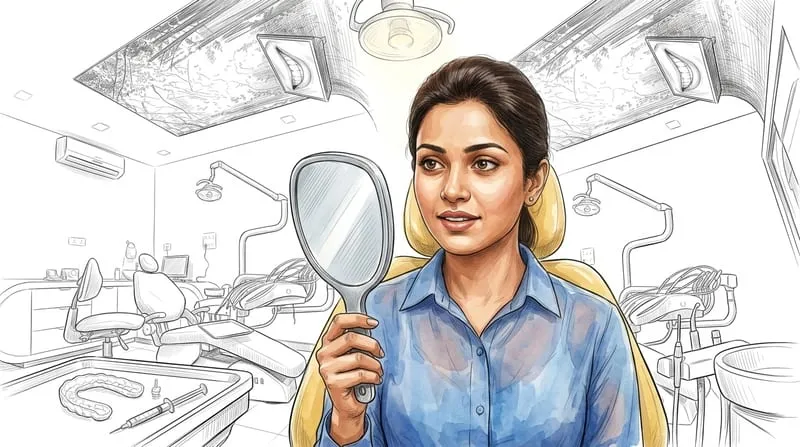
The clinical case and outcome are from Dr. Aashiba's practice.
Priya arrived on a Saturday afternoon in November, a bank employee from MP Nagar who had a wedding to attend in 6 weeks and had been looking at whitening options online for the past month. She was 28, had reasonably healthy teeth, and was troubled by a yellow-grey tint that she felt had worsened over the past 2 years of drinking 3 cups of tea daily at her desk.
"I tried one of those whitening strips for two weeks," she said, "but my teeth became very sensitive and I stopped. I've also seen charcoal toothpaste — is that good?"
The clinical examination was straightforward. Her teeth were in good health — no active cavities, no gum disease — but there was significant extrinsic staining from tea along the cervical third of the teeth and in the interproximal contact areas. Under the surface staining, the intrinsic shade was a B2 on the Vita guide, which is a natural ivory-yellow. She had no crowns or visible composite restorations in the smile zone, which simplified the planning considerably.
I explained the sequence to Priya clearly. "First we do a professional cleaning — scaling and air-polishing — to remove all the tea staining. That alone will make a visible difference. Then we do the in-clinic whitening session, which will lift the intrinsic shade. For the charcoal toothpaste — no. It abrades enamel. The sensitivity you had with the strips suggests they were sitting on the gum margin too long. Professional teeth whitening uses the same active ingredient but at a controlled concentration with proper isolation."
The cleaning appointment took 25 minutes. Priya looked at her teeth afterwards in the hand mirror and was visibly surprised — removing the tea staining had already shifted the apparent shade noticeably. "Can I just stop here?" she said, half-joking.
"You can," I told her, "but the intrinsic shade is still B2. If you want it lighter for the wedding, the in-clinic session will take it to around A1. That is a meaningful jump."
She booked the whitening session for the following week. Gum margins were isolated carefully before the peroxide gel was applied. The session took 60 minutes with 2 application cycles. The post-treatment shade measured A1. I gave her a desensitising gel to apply for 2 nights, advised her to avoid coffee, tea, and dark-coloured foods for 48 hours, and prescribed a maintenance whitening toothpaste for daily use.
She sent a message 3 days after the procedure. "No sensitivity at all — I was expecting the same problem as the strips but there was nothing. Everyone at the wedding asked if I had done something different."
At her follow-up 4 weeks later, the shade was holding at A1. She had cut her tea to 1 cup daily and was rinsing with water afterwards as advised. I reviewed her with a note for a maintenance touch-up in 18 months if needed.
BDS · Smile Gallery, Bhopal
| Follow-up | 4 weeks post-whitening |
| Shade change | B2 to A1 on Vita shade guide |
| Sensitivity | None reported post-treatment |
| Maintenance | Whitening toothpaste + reduced tea intake |
| Ongoing care | 6-monthly scaling, touch-up whitening at 18 months if needed |
Frequently Asked Questions
What does professional whitening involve?
A clinical exam, a professional cleaning if needed, application of a peroxide gel under controlled conditions, and one or two sessions in clinic.
Is whitening available at Smile Gallery in Bhopal?
Yes. Smile Gallery, in Arera Colony, offers in-clinic and take-home professional whitening under Dr. Saurabh Shrivastava (DCI: A-04860).
How long does the treatment take?
An in-clinic session takes 60 to 90 minutes. Take-home tray treatment runs over one to two weeks of nightly use.
What should I expect after whitening?
Mild cold sensitivity for one to three days. Avoid dark-staining foods for 48 hours.
How do I book a whitening consultation at Smile Gallery, Arera Colony?
Call +91 9200700750.
Ready for a consultation?
Visit Smile Gallery Dental Wellness Centre, E-4/205, Main Rd 3, near Flower Market, E-4, Arera Colony, Bhopal.
Open Monday to Saturday 10am–2pm and 5–9pm.