White spots on teeth are caused by enamel demineralisation, fluorosis during childhood, plaque, or trauma during enamel formation. Treatment ranges from improved oral care and fluoride remineralisation to microabrasion, resin infiltration, or veneers. Prevention centres on brushing, fluoride, and limiting sugar.
Medically reviewed by Dr. Kirti Shrivastava, BDS MDS, PhD Prosthodontist (DCI: A-01281). Last updated: May 2026.
White spots on teeth are caused by enamel demineralisation, fluorosis during childhood enamel formation, plaque accumulation, or earlier trauma to a developing tooth — and most cases respond to a graded approach: improved oral hygiene, fluoride remineralisation, and where needed microabrasion, resin infiltration, or aesthetic dental veneers and laminates such as veneers. Dr. Saurabh Shrivastava, BDS MDS Prosthodontist (DCI: A-04860) at Smile Gallery Dental Wellness Centre, Arera Colony, sees these regularly in patients from BHEL and across Bhopal. Catching enamel changes early prevents the cavities that follow; even when decay reaches the pulp, root canal therapy has a 95% success rate over 10 years.
What causes white spots on teeth?
White spots on teeth are usually early enamel damage. The common causes are plaque left around braces, too much fluoride while the teeth were forming in childhood, enamel that formed weak, and early decay that is not yet a cavity. Many improve with fluoride care or resin infiltration. At Smile Gallery, Bhopal, we first find which cause you have.
Causes of White Spots on Teeth
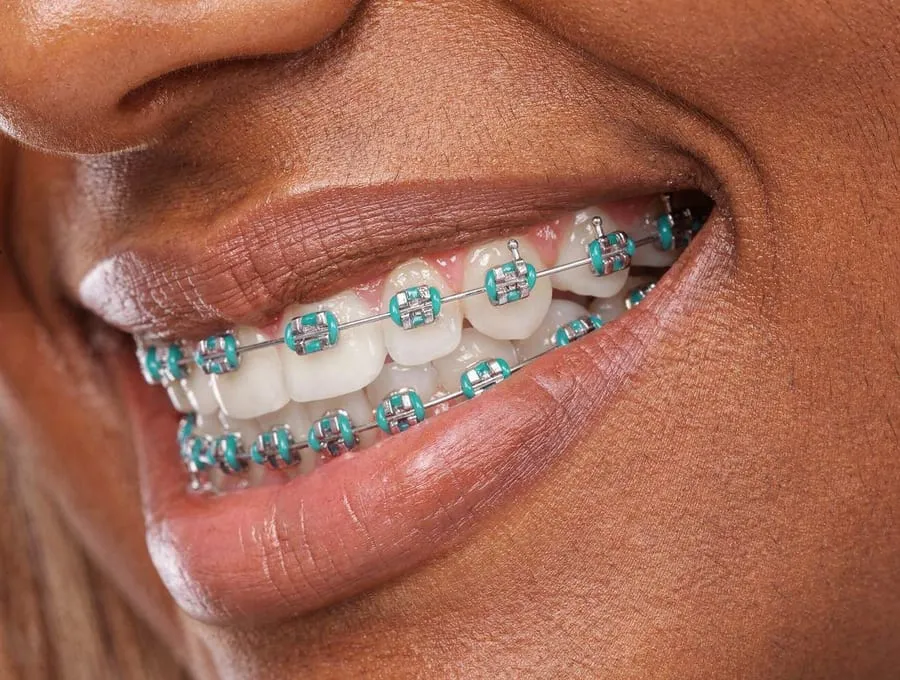
White spots indicate a change in the enamel — the protective outer layer of the tooth. The most common cause is enamel demineralisation, where calcium and phosphate are leached out by acids from plaque and sugar exposure. Fluorosis, caused by excess fluoride during childhood when teeth are still forming, leaves chalky white patches that are usually symmetrical. Plaque left undisturbed under braces or in hard-to-reach areas creates localised white scars. A knock to a baby tooth can also disturb the enamel of the underlying permanent tooth, leaving a single white area when it eventually erupts.
How White Spots Are Diagnosed
The dentist examines the teeth under good lighting, often with magnification, and considers the pattern. Symmetrical chalky bands across multiple teeth suggest fluorosis. Bands at the gum line of front teeth in someone who recently completed orthodontic treatment suggest demineralisation. A single white area on one tooth often points to past trauma. Photographs at high resolution help track changes over time.
According to Dr. Kirti Shrivastava, MDS, PhD Prosthodontist: "White spots under braces are almost entirely preventable — they appear at the gum line where patients stop brushing carefully because reaching around brackets is difficult. I spend time at every orthodontic review showing patients the exact angle and pressure needed around each bracket, because a demineralisation scar at 14 is visible for life."
Treatment Options — From Simple to Cosmetic
For early demineralisation, professional fluoride application combined with improved home care and a desensitising or remineralising toothpaste reverses many lesions over weeks to months. Microabrasion, in which a fine abrasive paste is applied for a few minutes, can remove superficial spots. Resin infiltration uses a low-viscosity resin that flows into the porous enamel and visually masks the spot. For deeper or stubborn cases, conservative composite bonding or porcelain veneers blend the spot into a uniform shade.
"Most patients who come in worried about white spots are relieved to learn that the most effective first step is also the simplest — professional fluoride application and a remineralising toothpaste. For early lesions, this alone reverses the process over weeks. We only move to microabrasion or resin infiltration when conservative care has reached its limit."
Dr. Kirti Shrivastava · BDS, MDS, PhD Prosthodontist, IPS-OL2283
Prevention Habits That Work
Brush twice a day with a soft-bristled brush and a fluoride toothpaste. Limit sugary snacks and drinks; if you have them, finish them in one sitting rather than grazing through the day. Use interdental brushes or floss daily to disturb plaque between teeth. For patients in fixed orthodontic treatment, special attention to the gum line and around the brackets is essential — that is where demineralisation typically appears. Children should use an age-appropriate amount of fluoride toothpaste under supervision.
- Not all white spots are the same — fluorosis spots are chalky, symmetrical, and present since childhood. Demineralisation lesions appear at the gum line or near brackets and may feel slightly rough to the tongue. A single white area on one tooth often traces back to childhood trauma. The cause determines the treatment.
- Early lesions can reverse without drilling — professional fluoride application combined with a remineralising toothpaste (containing hydroxyapatite or CPP-ACP) can restore mineral density in early lesions over four to eight weeks of consistent home use. No instrument touches the tooth.
- Microabrasion removes superficial spots in one visit — a fine abrasive paste buffed for a few minutes removes the surface layer containing the white spot. It works best for shallow fluorosis lesions and post-orthodontic spots that are contained to the outer enamel.
- Resin infiltration masks deeper spots without drilling — a low-viscosity resin flows into the porous enamel and changes its optical properties so the spot blends with the surrounding tooth. Results are visible immediately and the tooth structure is preserved entirely.
- Veneers are the final option, not the first — for deep, stubborn spots or those covering a large portion of the tooth surface, a conservative composite or porcelain veneer is the most reliable solution. This is considered only after simpler options have been evaluated.
- Prevention centres on brushing and fluoride — particularly for patients in fixed orthodontic treatment, dedicated brushing around brackets and regular in-clinic fluoride application prevents the majority of treatment-related demineralisation.
When to See a Dentist
Book a check-up if a white spot is new, growing, becoming rough, or visible from speaking distance. Most white spots are cosmetic and harmless, but any change in surface texture or shade can also indicate the early stage of a cavity that should be treated before it progresses.
According to Dr. Kirti Shrivastava, MDS, PhD Prosthodontist: "Resin infiltration is a technique that changed how we manage moderate demineralisation lesions — a low-viscosity resin flows into the porous enamel and optically masks the white spot without removing any tooth structure. For the right case, the result in one visit can be dramatic, and there is nothing to drill."
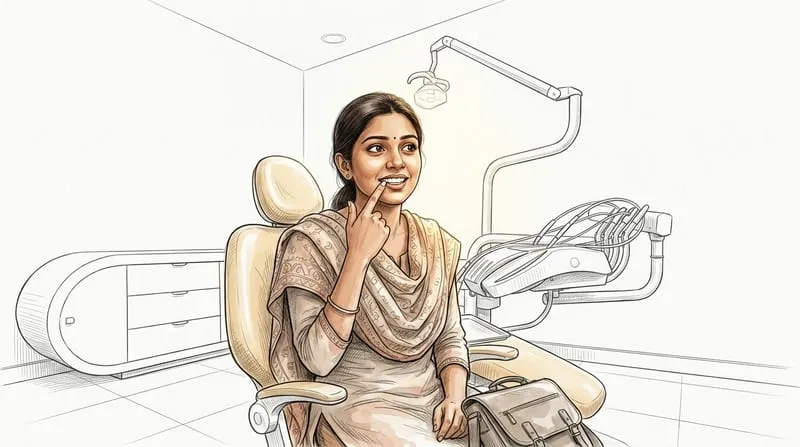
The clinical case and outcome are from Dr. Kirti Shrivastava's practice.
Neha came in on a Saturday morning in February, a college student from Shahpura, 22 years old, six months after finishing 18 months of fixed orthodontic treatment. She pulled up her lip to show me the upper front teeth the moment she sat down.
"My braces came off last August and I was so happy," she said. "But then I noticed these white patches at the gum line. They were not there before. I have been trying teeth whitening strips but it makes them look worse."
The examination confirmed what I expected. Post-orthodontic demineralisation lesions — 6 white spots in total, all at the gum line of the upper anterior teeth, all corresponding precisely to the bracket attachment sites from her recent treatment. The lesions were slightly chalky to the explorer at 3 of the 6 sites, indicating that enamel porosity was still active. The whitening strips had not helped because they bleach the surrounding tooth, increasing the visual contrast and making the white spots on teeth stand out more rather than less.
I explained the mechanism clearly. "These lesions formed because plaque was sitting undisturbed at the bracket edges during treatment — the bracket itself made brushing in that exact zone very difficult. The enamel lost mineral, which is what makes it look chalky and white. Whitening strips cannot fix this because they work on the same outer enamel — what you need is to restore the mineral that was lost."
I started with the most conservative approach: in-clinic fluoride varnish applied to all 6 lesions, followed by a 4-week course of daily remineralising toothpaste containing hydroxyapatite, applied with a finger directly to the lesions for 2 minutes before rinsing. I reviewed her at 6 weeks.
At that review, 3 of the 6 lesions had reduced noticeably in size and intensity — the enamel surface was smoother to the explorer and the optical contrast had diminished. The remaining 3 had partially improved but were still visible. I recommended resin infiltration for those 3 sites. The procedure took 40 minutes: the lesions were etched, dried, and infiltrated with low-viscosity resin that was light-cured in place. The result was immediately visible — the spots blended into the surrounding enamel without any drilling or preparation.
At her three-month follow-up, all 6 sites were stable. The 3 fluoride-managed lesions had continued to improve and were now only faintly visible under clinical lighting. The 3 infiltrated sites remained fully masked. She had discontinued the whitening strips entirely and was maintaining with fluoride toothpaste twice daily.
I will see her again at 12 months. If there is any residual appearance she is unhappy with, conservative composite bonding remains an option — but at this point, she said she was happy with the result and confident smiling again.
BDS, MDS, PhD Prosthodontist · DCI A-01281 · Smile Gallery, Bhopal
| Follow-up | 3 months (12-month review scheduled) |
| Fluoride-managed lesions | 3 of 6 spots resolved with fluoride varnish + remineralising toothpaste |
| Resin infiltration | 3 persistent spots masked in single visit — stable at 3 months |
| No drilling required | All 6 lesions treated without any tooth preparation |
| Ongoing care | 12-monthly review + fluoride toothpaste maintenance |
Frequently Asked Questions
What treatments are available for white spots?
Fluoride remineralisation, microabrasion, resin infiltration, conservative composite bonding, and veneers — chosen based on the cause and depth.
Are these treatments available at Smile Gallery in Bhopal?
Yes. Smile Gallery, in Arera Colony, evaluates and treats white spots from simple to complex cases under Dr. Saurabh Shrivastava (DCI: A-04860).
How long does treatment take?
Fluoride remineralisation runs over weeks of home care plus in-clinic fluoride application. Microabrasion and resin infiltration are usually completed in one visit. Veneers take two to three visits.
What should I expect after treatment?
Mild sensitivity to cold for one to two days after fluoride or resin treatment. Veneers may need a brief bite check at a follow-up visit.
How do I book an appointment at Smile Gallery, Arera Colony?
Call +91 9200700750.
Ready for a consultation?
Visit Smile Gallery Dental Wellness Centre, E-4/205, Main Rd 3, near Flower Market, E-4, Arera Colony, Bhopal.
Open Monday to Saturday 10am–2pm and 5–9pm.