

Full mouth rehabilitation restores broken-down or missing teeth and worn bites using crowns, implants, veneers, and bite reconstruction. The ten benefits cover appearance, chewing function, jaw comfort, oral health, digestion, speech, confidence, durability, prevention of further damage, and long-term value.
Medically reviewed by Dr. Saurabh Shrivastava, BDS MDS Prosthodontist, Certified Digital Smile Designer (DSD) (DCI: A-04860). Last updated: May 2026.
- 1. Restores the Smile’s Appearance
- 2. Brings Back Full Chewing Function
- 3. Eases Jaw Pain and TMJ Discomfort
- 4. Improves Long-Term Oral Health
- 5. Supports Better Digestion
- 6. Restores Clear Speech
- 7. Boosts Confidence
- 8. Long-Lasting and Durable
- 9. Prevents Further Damage
- 10. Long-Term Value
- Frequently Asked Questions
Full mouth rehabilitation restores extensive damage from decay, wear, missing teeth, or trauma using a coordinated combination of crowns, implants, veneers, and bite reconstruction — and the ten benefits stretch from improved appearance and chewing function to long-term oral health and confidence, as Dr. Saurabh Shrivastava, BDS MDS Prosthodontist (DCI: A-04860), Certified Digital Smile Designer at Smile Gallery Dental Wellness Centre, Arera Colony, regularly explains to patients from Habibganj. Where teeth are missing, dental implants in Bhopal are usually part of the plan; where teeth need root canal therapy as a salvage step, the procedure has a 95% success rate over 10 years.
1. Restores the Smile’s Appearance
Worn, chipped, dark, or missing teeth give the face an aged, tired look beyond what the years actually warrant. Full mouth rehabilitation rebuilds tooth proportion, shade, and arrangement so the smile looks natural and balanced for the face.
2. Brings Back Full Chewing Function
Patients often arrive having quietly avoided foods they used to enjoy — apples, nuts, raw vegetables, harder breads. Replacing missing teeth and rebuilding worn ones restores chewing efficiency close to natural levels, which improves both diet and digestion.
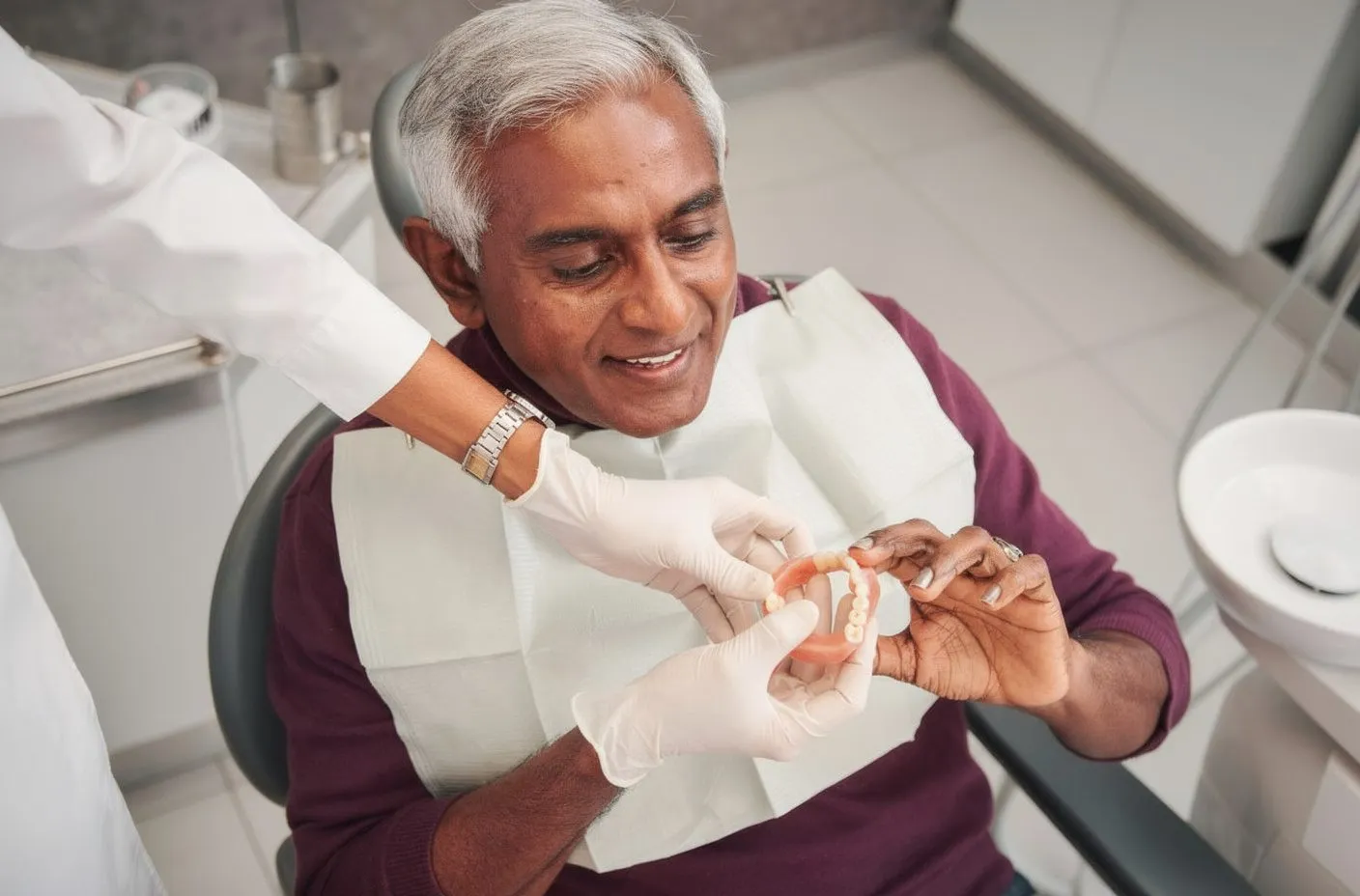
According to Dr. Saurabh Shrivastava, MDS Prosthodontist: "Full mouth rehabilitation is not a single procedure but a coordinated sequence — we stabilise the bite first, restore structure through crowns and implants, and only then refine aesthetics, because attempting cosmetic work on an unstable foundation leads to failures within two years."
3. Eases Jaw Pain and TMJ Discomfort
Worn teeth and missing back teeth force the jaw to settle into an uncomfortable position. Restoring the bite to a neutral, well-supported position eases TMJ tension, headaches, and neck discomfort that many patients did not realise was dental in origin.
"I have treated patients who came in thinking they needed a few fillings and left with a treatment plan spanning 5 months and 14 restorations — but every one of them, at the one-year follow-up, said it was the single best health decision they had made in the previous decade."
Dr. Saurabh Shrivastava · BDS, MDS Prosthodontist, DCI A-04860
4. Improves Long-Term Oral Health
Cracked teeth, leaking old fillings, and shifted bites all create traps for plaque. Rehabilitation creates clean, smooth, well-contoured surfaces that are far easier to keep healthy at home.
5. Supports Better Digestion
Food chewed properly enters the stomach in smaller pieces and starts digesting in the mouth thanks to saliva. Restored chewing function eases bloating, indigestion, and the post-meal discomfort that follows poor chewing.
According to Dr. Saurabh Shrivastava, MDS Prosthodontist: "Patients who complete full mouth rehabilitation in Bhopal often tell me that the most surprising benefit is digestive comfort — they had been unconsciously avoiding fibrous foods for years, and once chewing function is restored they notice the change in their gut health within weeks."
6. Restores Clear Speech
Missing front teeth and ill-fitting prostheses both affect speech. Replacing missing teeth and rebuilding the bite restores the small movements behind clear speech sounds.
7. Boosts Confidence
Confidence in a restored smile shows up in photos, in social settings, and in professional interactions. The change is often more emotional than clinical — and it is one of the reasons patients value the treatment most.
- A diagnostic phase comes first — Before any restoration is placed, photographs, X-rays, and bite analysis are completed. This phase usually takes one or two appointments and directly shapes the entire treatment plan; skipping it leads to restorations that fail to fit the bite.
- Staging protects your budget and your healing — Treatment is divided into phases: infection control first, then structural work such as implants and root canals, and finally crowns and veneers. Each phase allows tissues to heal before the next begins, improving predictability and spreading cost.
- Temporary restorations are part of the process — Provisional crowns worn for 6 to 12 weeks let us test the new bite before final restorations are made. If anything feels off during this trial period, adjustments are simple; after final cementation they are not.
- The bite is reconstructed, not just individual teeth — Full mouth rehabilitation addresses how all teeth meet together. Correcting a single tooth in an unstable bite is like replacing one tyre on a misaligned car — the repair will not last unless the underlying alignment is corrected.
- Maintenance determines longevity — Crowns, implants, and veneers placed during rehabilitation can last 15 to 25 years with twice-daily brushing, interdental cleaning, and six-monthly check-ups. Without maintenance, even the finest restorations deteriorate within 5 years. If rehabilitation is not yet accessible, a removable partial denture is a lower-cost interim option that preserves function while you plan for definitive treatment.
8. Long-Lasting and Durable
Quality crowns, implants, and veneers, planned and placed carefully, last for many years. Materials, technique, and sterilisation are not areas to compromise on, and that is reflected at the Arera Colony clinic.
9. Prevents Further Damage
Untreated wear and missing teeth create a cycle of further damage as the bite shifts and remaining teeth carry more force. Rehabilitation interrupts that cycle and protects the structures that remain.
10. Long-Term Value
A coordinated rehabilitation done once is generally more economical over the long run than repeated patching of individual teeth across many years.
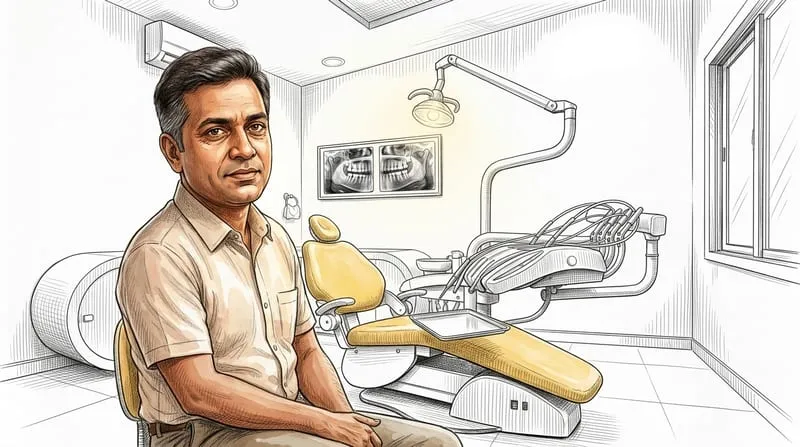
The clinical case and outcome are from Dr. Saurabh Shrivastava's practice.
Rajendra walked in on a Tuesday afternoon in October, referred by his neighbour in Govindpura who had told him bluntly: "Go to Dr. Saurabh. Stop waiting." He was 48, a retired BHEL engineer, and he had been living with a mouth in slow decline for nearly a decade.
The picture he described was familiar. Three missing teeth on the lower left — extracted years ago, replacements never done. The upper front crowns placed by a now-retired dentist were 11 years old and one had fractured at the margin. His back molars were so worn from night grinding that the upper and lower teeth met flat, like two pieces of slate. Chewing on the right side was painful. He had been mashing food on the left instead, and even that had become unreliable.
The examination took nearly an hour. I took full-arch photographs, a panoramic X-ray, and periapical films of every symptomatic tooth. Study models were made so I could analyse the bite outside the mouth. What I found confirmed the clinical story: the lower left had significant bone loss at the edentulous sites from years without implants. The fractured upper crown had secondary decay at the margin extending subgingivally on one root. 2 upper premolars needed root canal treatment before crowns could be placed. The night grinding had worn nearly 3 mm of enamel from the posterior surfaces.
"How long will all this take?" he asked, looking at the treatment plan I had printed. I told him honestly: 5 months if we phased it correctly. "My son's wedding is in January," he said. "I want to be able to eat properly at the baraat." That gave us exactly the timeline we needed.
We began with infection control. The decay under the fractured crown was removed and a temporary restoration placed. Root canal treatment on the 2 premolars was completed over 2 appointments. Scaling and root planing brought the gum inflammation under control. Then, in November, we placed 3 implants in the lower left — one for each of the missing molars and one for the missing premolar. These were left to osseointegrate for 10 weeks while we continued planning the upper arch.
In December we fabricated 6 zirconia crowns for the upper posterior teeth, including the 2 root-canal-treated premolars and the fractured front crown. A new vertical dimension of occlusion — the height at which the upper and lower teeth meet — was established 2 mm higher than the worn-down original. Provisional crowns were worn for 5 weeks while Rajendra confirmed the new bite was comfortable. He called mid-December to say "the provisionals feel completely normal — I forgot they were there." That was the confirmation we needed.
Final restorations were seated in the first week of January. The 3 implant crowns in the lower left, 6 zirconia crowns on the upper arch, and a full mouth rehabilitation that had transformed a mouth held together by compensation into one that worked as a coordinated system. At his son's wedding, Rajendra ate biryani, chewed on both sides, and smiled in every photograph.
At the six-month follow-up, bone levels around the implants were stable on X-ray. The new vertical dimension had been accepted completely — no jaw joint symptoms, no headaches. He brought his wife in shortly after. "She says I look 10 years younger," he told me. I said the credit belonged to the bone that had held the implants, and to the January deadline he had refused to miss.
BDS, MDS Prosthodontist · DCI A-04860 · Smile Gallery, Bhopal
| Follow-up | 6 months post-rehabilitation |
| Implants (×3) | Osseointegration confirmed on X-ray, bone levels stable |
| Zirconia crowns (×6) | All margins sealed, no secondary decay, full occlusal contact |
| Bite reconstruction | New vertical dimension accepted, zero TMJ symptoms or headaches |
| Chewing function | Bilateral chewing restored, no avoidance of fibrous or hard foods |
| Ongoing care | 6-monthly check-up + annual X-rays + night guard for bruxism |
Frequently Asked Questions
What does full mouth rehabilitation involve?
A complete clinical exam, photographs, X-rays, CBCT where indicated, a digital smile design preview, and a coordinated combination of treatments delivered in a planned sequence.
Is full mouth rehabilitation available at Smile Gallery in Bhopal?
Yes. Smile Gallery, in Arera Colony, plans and delivers full-mouth cases under Dr. Saurabh Shrivastava (DCI: A-04860), Certified Digital Smile Designer.
How long does the treatment take?
Three to nine months for most cases, depending on whether implants and bone work are included.
What should I expect after rehabilitation?
A short adjustment period to the new bite. The dentist reviews and refines the bite at follow-up visits.
How do I book a consultation at Smile Gallery, Arera Colony?
Call +91 9200700750.
Ready for a consultation?
Visit Smile Gallery Dental Wellness Centre, E-4/205, Main Rd 3, near Flower Market, E-4, Arera Colony, Bhopal.
Open Monday to Saturday 10am–2pm and 5–9pm.