

Dental anxiety is a common, manageable fear of dental visits. Helpful strategies include scheduling a relaxed first appointment, using simple breathing techniques, asking the dentist to explain each step, choosing morning slots, and bringing a companion. Treatment is rarely as difficult as the anticipation.
Medically reviewed by Dr. Saurabh Shrivastava, BDS MDS Prosthodontist, Certified Digital Smile Designer (DSD) (DCI: A-04860). Last updated: May 2026.
Dental anxiety — a common fear of dental visits ranging from mild nervousness to outright panic — is best managed with a few practical strategies: a relaxed first appointment without treatment, slow breathing techniques, clear step-by-step explanations from the dentist, morning slots when energy is highest, and a trusted companion if helpful. Dr. Saurabh Shrivastava, BDS MDS Prosthodontist (DCI: A-04860) at Smile Gallery Dental Wellness Centre, Arera Colony, applies this calm, paced approach for patients from Habibganj and beyond. Most procedures, including painless dentistry in Bhopal as involved as root canal therapy (which has a 95% success rate over 10 years), are far more comfortable than the anticipation suggests.
What Causes Dental Anxiety
Dental anxiety has many sources. A bad experience years ago — perhaps in childhood — can stay with someone for life. The unfamiliar sounds and smells of a clinic, the loss of personal control while reclining in the chair, the fear of pain, embarrassment about the state of the teeth, and the financial unknown all contribute. None of these are unreasonable, and recognising them is the first step in addressing them.
Strategies That Genuinely Help Before the Appointment
Book a first appointment that is just a consultation, with no treatment planned. Eat a light meal beforehand so blood sugar is stable. Avoid caffeine, which amplifies physical anxiety symptoms. Practice slow nasal breathing — four seconds in, six seconds out — for a few minutes before walking in. Bring a friend or family member; many clinics allow a companion to stay during the consultation. Tell the receptionist you are anxious; the team can plan a longer slot.
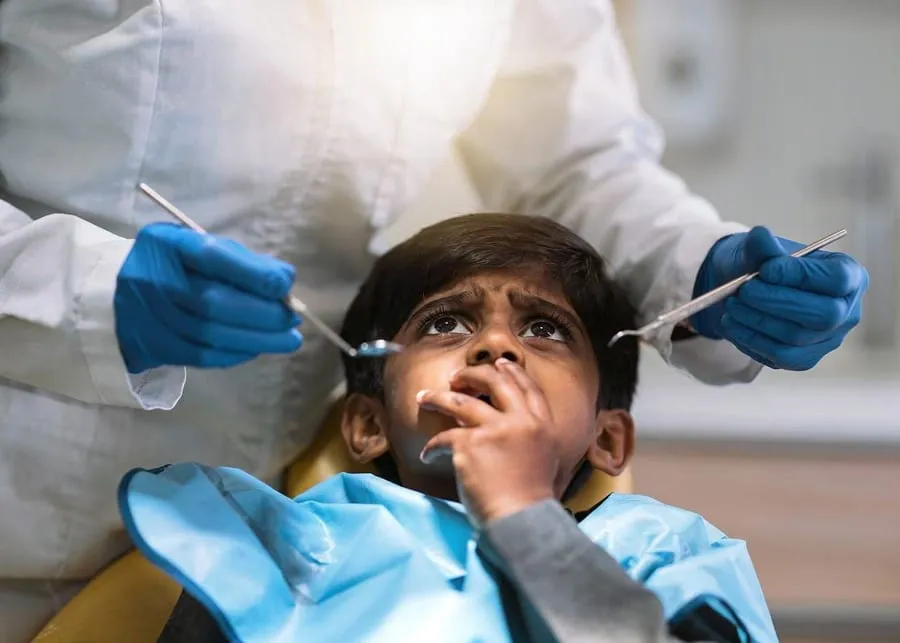
According to Dr. Saurabh Shrivastava, MDS Prosthodontist: "Dental anxiety is not a personality flaw — it is a conditioned fear response, often rooted in a single painful experience from childhood, and the most effective way to break it is not reassurance but transparency: showing the patient every instrument before it is used, explaining every sensation before it is felt, and giving them genuine control to pause the procedure at any moment."
How a Calm Clinic Reduces Anxiety
Lighting, pace, and language all matter. The dentist who pauses, shows you the X-ray, walks you through what they see, explains options without rushing, and offers genuine pauses for questions, is doing more than describing treatment — they are reducing your stress response. Hand signals (raise your hand to pause) give back control. Anaesthesia is administered slowly and comfortably. Step-by-step warnings before each new sensation — a vibration, a cool spray of water — remove the surprise that triggers anxiety.
"I have had patients grip the armrest so hard at the start of an appointment that their knuckles were white — and leave with a filled tooth, a smile, and the words: 'That was nothing like I expected.' The anticipation of dentistry is almost always worse than the procedure itself."
Dr. Saurabh Shrivastava · BDS, MDS Prosthodontist, DCI A-04860
Sedation and Comfort Options
For severe anxiety, options include nitrous oxide (laughing gas) for short procedures and oral sedation for longer ones, both of which keep the patient comfortable while remaining responsive. These are not used routinely; they are reserved for situations where they genuinely help. The right option is decided after a discussion of medical history and the planned procedure.
- Book a no-treatment first appointment — Ask specifically for a consultation where nothing will be done to your teeth. Walk through the clinic, meet the dentist, ask every question you have. Familiarity with the environment removes the biggest unknown and reduces anticipatory anxiety by 40 to 60% for most patients.
- Use a stop signal — Agree a hand signal with your dentist before the appointment begins. Raising your left hand means stop immediately, no questions asked. Knowing you have real control over the procedure is more calming than any verbal reassurance, because it converts you from a passive recipient into an active participant.
- Request tell-show-do for every step — Ask the dentist to name the instrument, show it to you, and explain what it will feel like before it touches your mouth. This technique, standard in paediatric dentistry, works equally well for adults because it converts fear of the unknown into manageable expectation.
- Choose a morning appointment — Anxiety accumulates throughout the day. A morning slot means less time to catastrophise in the waiting room and a fresher, more focused dentist. Avoid late afternoon appointments when both patient and clinician are at their most fatigued.
- Control sound and sensation with earphones — The drill sound triggers anxiety disproportionate to the actual sensation. Wearing earphones with music or a podcast reduces auditory stress significantly. Ask your dentist in advance — most modern clinics accommodate this request without hesitation.
- Discuss sedation options for severe anxiety — For patients who cannot complete treatment despite the above strategies, conscious sedation with oral midazolam or inhalation sedation (relative analgesia with nitrous oxide) allows treatment to proceed comfortably. At Smile Gallery, we assess every severe-anxiety patient individually and discuss sedation as a clinical tool, not a last resort. Avoiding treatment entirely is never the safer option.
Building Confidence Visit by Visit
Anxiety almost always reduces after the first or second visit, once the patient sees the actual experience does not match the imagined one. A calm cleaning, a small filling, a routine check-up — each becomes a building block for handling later, more involved procedures with much less stress. The aim is not to push through fear but to make each visit a slightly easier reference point than the last.
According to Dr. Saurabh Shrivastava, MDS Prosthodontist: "The patients who suffer most from dental anxiety are not the ones who come in nervous — they are the ones who never come in at all. By the time fear drives them to finally attend, a filling has become a root canal and a gum problem has become bone loss. Managing anxiety early is not a comfort measure; it is a clinical intervention that prevents irreversible damage."
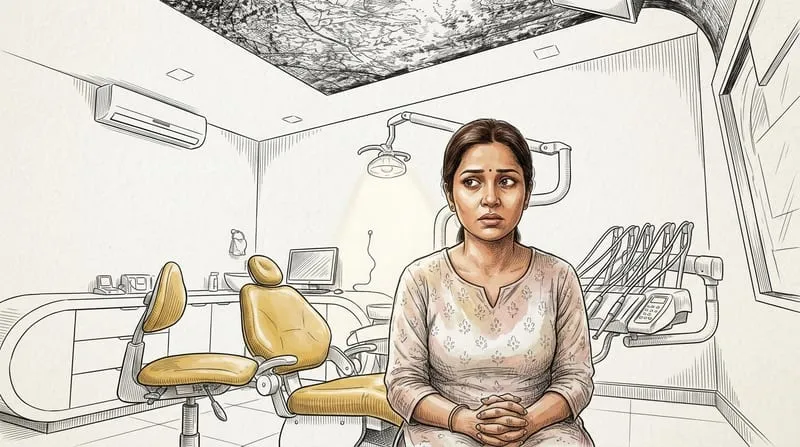
The clinical case and outcome are from Dr. Saurabh Shrivastava's practice.
Priyanka sat down in the consultation chair and immediately gripped both armrests. She was 34, a schoolteacher from Shahpura, and she had not been inside a dental clinic in 7 years. Her husband had made the appointment. She had cancelled it twice before finally coming in.
"I know it is irrational," she said, before I had asked a single question. "I had a bad extraction when I was 12. The dentist didn't give enough anaesthetic and didn't stop when I cried. I swore I would never go back." She had kept that promise for over two decades, managing toothaches with painkillers and avoiding the mirror.
The dental anxiety had cost her significantly. When I examined her, the clinical picture was what 7 years of avoidance looks like: heavy generalised calculus, a lower left molar with a deep cavity that had reached the pulp, and 3 other teeth with early to moderate decay. None of this was irreversible yet — but another year and extractions would have entered the plan.
I did not pick up an instrument for that entire first appointment. I showed her each one on the tray, named it, and explained what it felt like. I showed her the local anaesthetic syringe and described the pinch and the numbness. I told her we would agree a hand signal — raised left hand meant stop, instantly, no exceptions. "Can I really stop any time?" she asked. "Any time," I said. "Even in the middle of something?" "Especially then."
The second appointment was a scaling — no drilling, no needles, just the ultrasonic scaler. I narrated every step. She raised her hand twice in the first 5 minutes. Both times I stopped immediately and waited. By the end of the appointment — 45 minutes of cleaning — she had not raised it once in the final 20 minutes. "That wasn't as bad as I thought," she said. Those were the words I had been waiting for.
The dental anxiety that had defined her relationship with dentistry for 22 years began to shift at the third appointment, when we started the root canal on the lower left molar. I used topical anaesthetic before the injection, a fine-gauge needle, and deposited the solution slowly over 90 seconds. She felt a pinch and then nothing. 65 minutes later, the canal was cleaned, shaped, and sealed. She had not raised her hand once.
Over the following 3 months, we completed the 3 composite fillings, placed a zirconia crown on the root-canal-treated molar, and did a second scaling. Each appointment she arrived a little less rigid in the chair. At the final appointment she actually laughed at something I said mid-procedure — her jaw was completely relaxed. Her husband texted me afterwards: "She is a different person. Thank you."
She comes every six months now, on her own, without prompting from anyone. At her most recent check-up she told me she had referred 4 of her students' parents to the clinic — people she knew were avoiding dentistry the way she once had. "I tell them what you told me," she said. "That the anticipation is always worse than the thing itself." I could not have said it better.
BDS, MDS Prosthodontist · DCI A-04860 · Smile Gallery, Bhopal
| Follow-up | 12 months across 5 appointments |
| Root canal (×1) | Completed without sedation, asymptomatic at 12 months |
| Composite fillings (×3) | All intact, no post-operative sensitivity |
| Anxiety level | From severe avoidance (7 years) to routine 6-monthly attendance |
| Gum health | Generalised gingivitis resolved after 2 scaling sessions |
| Ongoing care | 6-monthly check-up, self-initiated, no prompting required |
Frequently Asked Questions
What does the first visit for an anxious patient involve?
Usually a relaxed conversation, an examination, photographs and X-rays as needed, and a written treatment plan. No active treatment unless the patient feels ready.
Is anxiety-friendly care available at Smile Gallery in Bhopal?
Yes. Smile Gallery, in Arera Colony, takes time to explain procedures step by step and discusses sedation options where appropriate.
How long does an anxiety-friendly first appointment take?
About 45 minutes — slightly longer than a standard slot — so there is no sense of being rushed.
What should I expect after the first visit?
A clear written plan, a calm sense of what comes next, and the option to schedule the next step at your own pace.
How do I book an appointment at Smile Gallery, Arera Colony?
Call +91 9200700750 and mention that you would like a longer slot. The team will accommodate.
Ready for a consultation?
Visit Smile Gallery Dental Wellness Centre, E-4/205, Main Rd 3, near Flower Market, E-4, Arera Colony, Bhopal.
Open Monday to Saturday 10am–2pm and 5–9pm.