


Six signs you may need root canal treatment: persistent toothache, hot or cold sensitivity that lingers, tooth discoloration, swollen or tender gums, a recurring pimple on the gum, and a cracked or deeply decayed tooth. Get evaluated promptly at Smile Gallery, Arera Colony.
Medically reviewed by Dr. Saurabh Shrivastava, BDS MDS Prosthodontist, Certified Digital Smile Designer (DSD) (DCI: A-04860). Last updated: May 2026.
The six classic signs you may need a root canal — persistent toothache, lingering sensitivity to hot or cold, darkening of the tooth, swollen or tender gums, a recurring gum boil, and a cracked or deeply decayed tooth — all point to an infected or inflamed pulp, a condition Dr. Saurabh Shrivastava, BDS MDS Prosthodontist (DCI: A-04860) at Smile Gallery Dental Wellness Centre, Arera Colony, sees regularly in patients from Awadhpuri and surrounding areas. Modern root canal treatment has a 95% success rate over 10 years, and catching these signs early dramatically improves the outcome.
Sign 1 — Persistent Toothache Needing Root Canal Treatment
A spontaneous, throbbing ache that wakes you at night, builds slowly through the day, or returns each time you bite on a particular tooth is the most common sign of pulp inflammation. Painkillers may dull the pain temporarily but cannot resolve the underlying cause. The longer this is ignored, the more likely the infection is to reach the surrounding bone.
Sign 2 — Hot or Cold Sensitivity That Lingers
Brief sensitivity to ice cream or hot tea is common and often harmless. The warning sign is sensitivity that persists for 30 seconds or more after the trigger is removed, or pain that comes from heat alone. This pattern typically means the pulp is inflamed and is unlikely to recover on its own.
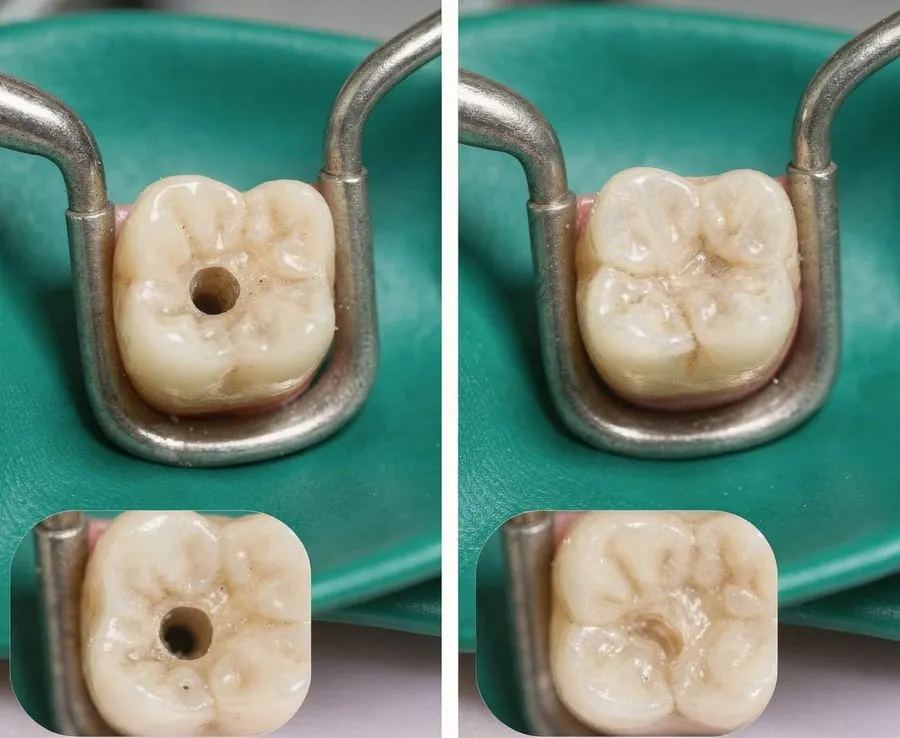
According to Dr. Saurabh Shrivastava, MDS Prosthodontist: "A persistent toothache that returns each time you bite — or wakes you at night — is almost never a coincidence; it is inflamed or infected pulp, and every week of delay allows the bacteria to reach the surrounding bone, turning a straightforward root canal into a more involved procedure. Modern single-sitting root canal treatment under local anaesthesia resolves this completely in about 60 minutes."
Sign 3 — Tooth Discoloration
A single tooth that turns grey, brown, or pinkish-yellow compared to its neighbours often indicates that the pulp inside has died. The discoloration comes from the breakdown products of the dead pulp staining the inner tooth structure. Whitening will not correct this — root canal treatment, sometimes followed by internal bleaching or a veneer or crown, is needed.
"I tell every patient who hesitates at the words 'root canal' the same thing: the procedure does not cause pain — it ends the pain that brought you here. A tooth treated and crowned today can serve you for another 20 years; a tooth extracted today leaves a gap that costs significantly more to fill."
Dr. Saurabh Shrivastava · BDS, MDS Prosthodontist, DCI A-04860
Sign 4 — Swollen or Tender Gums
Localised swelling of the gum next to a single tooth, especially when accompanied by tenderness on biting or pressing the tooth, suggests the infection has reached the tip of the root and is leaking into the surrounding tissue. This requires prompt evaluation; in some cases, antibiotics are needed before the root canal procedure.
According to Dr. Saurabh Shrivastava, MDS Prosthodontist: "The recurring gum pimple — what clinicians call a sinus tract — is the sign patients miss most often because it causes little pain; the body is quietly draining a chronic infection at the root tip, and without treatment the bone around that root is being slowly destroyed. An X-ray confirms it in seconds, and a root canal resolves both the infection and the lesion reliably."
Sign 5 — Recurring Pimple on the Gum (Sinus Tract)
A small pimple-like bump on the gum that appears, drains, and reappears is a sinus tract — a channel created by the body to release pressure from a chronic infection at the tip of a tooth root. It often comes with little or no pain, which is why it is missed for years. An X-ray usually shows a dark area around the root, and root canal treatment resolves both the infection and the gum lesion.
- Persistent toothache — A spontaneous, throbbing ache that builds through the day or wakes you at night is the most common sign of pulp inflammation. Painkillers mask the symptom but cannot treat the underlying infection.
- Lingering hot or cold sensitivity — Brief sensitivity to temperature is common and usually harmless. The warning sign is sensitivity that persists for 30 seconds or more after the trigger is removed, or pain triggered by heat alone — both indicate inflamed pulp unlikely to recover without treatment.
- Tooth discoloration — A single tooth that turns grey, brown, or pinkish-yellow compared to its neighbours usually means the pulp inside has died. Whitening cannot correct this; root canal treatment, sometimes followed by a crown or veneer, is the solution.
- Swollen or tender gums near one tooth — Localised swelling next to a single tooth suggests the infection has spread beyond the root tip into surrounding tissue. Prompt evaluation is needed; antibiotics may be required before the root canal.
- Recurring pimple on the gum — A bump that appears, drains, and returns is a sinus tract — the body releasing pressure from a chronic infection. It often causes little pain, which is why patients miss it for years. An X-ray shows a dark halo around the root.
- Cracked or deeply decayed tooth — A crack that causes sharp pain when biting, or a cavity that has reached close to the nerve, puts the pulp at direct risk. Root canal treatment preserves the natural tooth; extraction, and subsequent replacement, costs far more in time and money.
Sign 6 — Cracked or Deeply Decayed Tooth
A visible crack, a tooth that hurts only when chewing on something hard, or a cavity that has reached close to the nerve all put the pulp at risk. Once decay or a fracture extends into the pulp chamber, root canal treatment is the only way to keep the natural tooth. Extraction is the alternative — but a treated tooth, supported by a crown, can serve for decades.
What to Do If You Notice These Signs
Book a dental check-up the same week you notice any of these signs. The dentist will perform a clinical exam, sensitivity tests, and a digital X-ray to confirm whether root canal treatment is needed. Catching the problem early often means the procedure can be completed in a single visit.
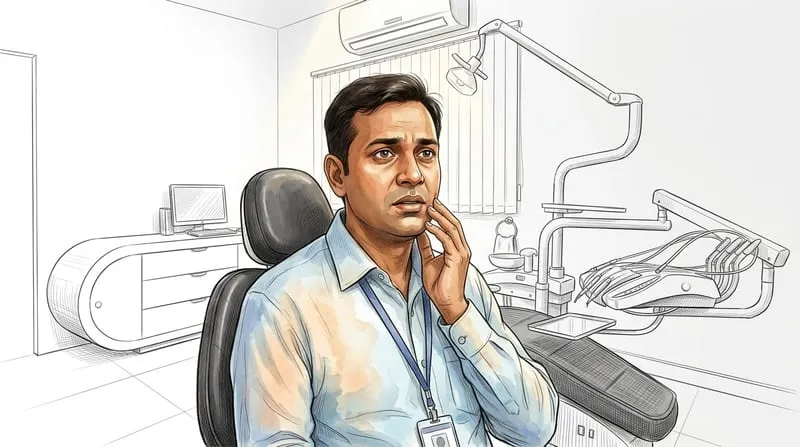
The clinical case and outcome are from Dr. Saurabh Shrivastava's practice.
Rajesh arrived on a Tuesday evening in September, his cheek slightly swollen, his right hand pressed against his jaw. He was 42, a senior accounts officer at a government department in TT Nagar, and had been tolerating a throbbing toothache for 11 days. He had taken painkillers daily. The pain would subside for a few hours, then return by nightfall.
"I kept thinking it would go on its own," he said, settling into the chair. "But last night it woke me up at 2 in the morning. My wife insisted I come today."
The clinical picture was clear. The upper left first molar had a large restoration placed several years earlier — the margins had broken down, and secondary decay had reached the pulp. The tooth tested negative to cold, indicating pulp necrosis. Percussion was sharply positive. The periapical X-ray showed a small but unmistakable periapical radiolucency — a dark halo around the root tip where the bone was beginning to dissolve. The root canal could not wait.
I explained the X-ray findings directly. "The nerve inside this tooth has died and the infection has reached the bone at the tip of the root. That is what is causing the overnight pain — the pressure has nowhere to go. A root canal removes the infected tissue, clears the canals, and seals everything. The bone usually heals completely within 3 to 6 months."
Rajesh had heard the words 'root canal' before and his expression said everything. "Will it be painful?" he asked.
"The procedure itself is done under local anaesthesia. You will feel pressure but not pain. The pain you have right now — that ends the moment we decompress the canal." He nodded, and we began.
Access was straightforward. The canals — 3 in this upper molar — were negotiated, measured with an apex locator, and cleaned with rotary files to working length. Copious irrigation with sodium hypochlorite. The relief on his face when the anaesthesia set in and the pressure drained was visible. Total chair time: 65 minutes. A temporary restoration was placed and he was given a short course of antibiotics given the existing periapical infection.
He returned 10 days later for the second visit. The periapical tenderness had resolved completely. The canals were obturated with gutta-percha and sealer. A full-coverage zirconia crown was fitted 3 weeks after that — the tooth needed the protection, given how much structure had been lost to the original decay.
"I wasted 11 days in pain for a 65-minute procedure," he said at the crown fitting, half laughing. "Nobody tells you it is this straightforward." At his 6-month X-ray review, the periapical lesion had resolved entirely. The bone had healed. He has attended every six months since and has referred 3 colleagues from his office who had been avoiding their own dental problems.
BDS, MDS Prosthodontist · DCI A-04860 · Smile Gallery, Bhopal
| Follow-up | 12 months post-treatment |
| Pain resolution | Complete within 48 hours of root canal; overnight pain gone by next morning |
| Periapical healing | Radiolucency resolved on 6-month X-ray; bone fully healed |
| Zirconia crown | Intact, occlusion balanced, no sensitivity |
| Ongoing care | 6-monthly check-up + annual periapical X-ray for treated tooth |
Frequently Asked Questions
What does a root canal procedure involve?
The infected pulp is removed under local anaesthesia, the canals are cleaned and shaped, disinfected, and sealed. A crown is usually placed afterwards to protect the tooth.
Is root canal treatment available at Smile Gallery in Bhopal?
Yes. Smile Gallery, in Arera Colony, offers single-sitting and multi-visit root canal treatment under Dr. Saurabh Shrivastava (DCI: A-04860).
How long does the treatment take?
Most teeth are completed in 60 to 90 minutes. The follow-up crown is usually fitted within two to four weeks.
What should I expect after the procedure?
Mild biting tenderness for two to three days. Most patients return to work the same day and resume normal eating within a week.
How do I book an appointment at Smile Gallery, Arera Colony?
Call +91 9200700750. Same-day slots are usually available for active dental pain.
Ready for a consultation?
Visit Smile Gallery Dental Wellness Centre, E-4/205, Main Rd 3, near Flower Market, E-4, Arera Colony, Bhopal.
Open Monday to Saturday 10am–2pm and 5–9pm.
